Zionism is not a settled historical subject and this path does not treat it as one. The same movement is described in serious scholarship as the national liberation movement of a persecuted people and as a settler-colonial project, and the books making each case are written by careful historians rather than by cranks. So every book below carries a label for the position it argues from, and the order puts the movement's own founding texts before anybody's interpretation of them.
What this list will not do is tell you which reading is right. The aim is that you can state each position in the form its own best defenders would recognise.
What the founders actually wrote
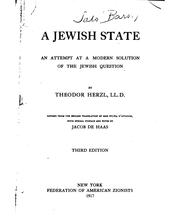
Start with Herzl. A Jewish State is Der Judenstaat, the 1896 pamphlet that turned a scattered set of ideas into a political movement with an address — short, oddly practical, and much stranger than its reputation. It is on the path as a primary source, not as an account of anything. Note the catalogue record: the widely held English text is the old De Haas translation, filed under this title, and both translators are listed alongside Herzl in the author field.
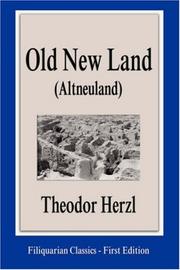
Old New Land (Altneuland) is Herzl's 1902 utopian novel and the necessary companion, because it contains his imagined answer to the question of the Arabs already living in Palestine — an answer that reads very differently depending on which later historian you have read first. Which is the argument for reading it now, before anyone tells you what to make of it.
The Zionist idea is Arthur Hertzberg's anthology, and it is how you meet the strands Herzl did not represent: Ahad Ha'am's cultural Zionism, Pinsker, A. D. Gordon's labour Zionism, Jabotinsky's revisionism, Rav Kook's religious Zionism. Hertzberg's framing is sympathetic and his introduction is itself an argument, but the primary texts are the point, and they stop you mistaking Herzl for the whole movement.
The sympathetic intellectual history
The making of modern Zionism is sympathetic and the best short intellectual history on the list. Shlomo Avineri, an Israeli political theorist, reads Zionism as a revolution in Jewish self-understanding produced by European modernity rather than as a continuation of religious longing for Zion.
A history of Zionism is Walter Laqueur's, also sympathetic and far more granular: the standard narrative from the precursors to 1948, strong on the congresses, the factional fights and the diplomacy. It is dated in places and was written before the Israeli archives opened, which is precisely why it belongs before the revisionists. It is the account they were revising.
The strands, and the critique from within Israel
Land and power is sympathetic but unsparing. Anita Shapira traces how the Zionist labour movement moved from a genuine ethos of restraint to the embrace of force between 1881 and 1948, and she is not writing an indictment.
The founding myths of Israel is critical, from the Israeli left. Zeev Sternhell argues that labour Zionism's socialism was largely instrumental — nationalism in socialist clothes — and that the kibbutz-and-equality story Israelis tell about their founding is substantially a myth. Read it straight after Shapira; the two work the same material to different conclusions.
Jabotinsky gives the revisionist strand its own book, which it needs, since it is the ancestor of the political right that has governed Israel for most of the last fifty years. Hillel Halkin is sympathetic and candid about the Iron Wall doctrine: Jabotinsky's frank argument that Arab consent was unobtainable and that Zionism would have to proceed behind superior force.
1948, and two historians who disagree
Righteous victims is Benny Morris's one-volume history of the conflict from 1881, and it doubles as the baseline narrative of the state's founding. Morris is revisionist on the evidence and hawkish in his later politics, a combination that makes him hard to place and worth reading closely. His archival monograph on the refugee question, The Birth of the Palestinian Refugee Problem Revisited, is the more important book for 1948 specifically and is not in our catalogue.
The Iron Wall is Avi Shlaim, from the same revisionist generation, arguing that Israeli policy toward the Arab world has followed Jabotinsky's logic for seventy years, including at moments when a settlement was available. Morris and Shlaim worked from overlapping archives and reached opposite political conclusions, and reading them against each other is the clearest available demonstration that the disagreement here is not simply about facts. This path does not adjudicate between them.
From the other side of the argument
The Question of Palestine is anti-Zionist, and it is the text that put the Palestinian case into Anglophone intellectual life: Edward Said's argument that European Jewish national liberation and Palestinian dispossession were the same event. It is polemical, and most of the historians above answer it.
The Iron Cage is critical and scholarly where Said is polemical. Rashid Khalidi examines why Palestinian national leadership failed under the Mandate, and is as hard on that leadership as on the British and the Yishuv. His later book, The Hundred Years' War on Palestine, is the fuller statement of the settler-colonial reading; this one covers the period the earlier stages do.
Army of shadows discomfits everyone: Hillel Cohen, an Israeli historian, on Palestinian collaboration with the Zionist movement between 1917 and 1948, which complicates the two-monolithic-camps picture both narratives depend on. The accidental empire closes the path where the argument has become contemporary — Gershom Gorenberg's archival history of the first decade of settlement after 1967, a project he shows nobody quite decided on and nobody stopped.
The full ordered path, with the standpoint noted on every book, is at the Zionism reading path.