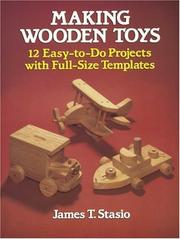
Start with James Stasio's Making wooden toys, but know what you are buying: our record runs to 16 pages. It is a plans booklet, not a manual — a set of simple patterns for push-along toys you can cut from offcuts in an evening. That is still the right first thing to own, because the first few toys are practice at wheels, axles and sanding rather than exercises in design. Just do not expect it to teach you technique.
Wooden toy making has a small literature. The ten books here are close to the whole of it in English, and they sort themselves by what the toy has to survive: being thrown, chewed and dropped down stairs, without a finish or a small part that can hurt the child holding it. None of these books is a substitute for the toy-safety rules in force where you live — small-parts sizing and finish certification both change, and several of these titles predate the current standards.
First toys, from offcuts
After Stasio, Making wooden toys & games is the beginner book with actual teaching in it. Jeff Loader is the best of these authors on process — marking out, cutting, cleaning up — and he mixes toys with simple games so the projects stay varied while the skills repeat. The ampersand is how it was published.
Making Toys That Teach is Les Neufeld on shape sorters, stacking puzzles and posting boxes, and it belongs third because it is where accuracy starts to matter: a shape that will not drop through the hole is a broken toy, not a near miss. Read it once your cuts are clean enough for tolerance to be a real question.
Joinery-grade toys
Making heirloom toys is Jim Makowicki's step up in ambition — doll's houses, rocking toys and vehicles built to furniture standards, in hardwood, with mortise-and-tenon joinery. It assumes the beginner skills and spends its 151 pages on structure instead.
Making board, peg & dice games is Loader again, and it is the fussiest accuracy work on the whole path: turned pegs, drilled grids, inlaid boards. A useful sideways move before mechanisms, because a peg that does not fit is a visible failure.
Making it move
How to make animated toys is David Wakefield's classic on cams, cranks and linkages — turn a handle, and something walks, pecks or rows. At 309 pages it is the longest book here and the first that asks you to think in mechanisms rather than in shapes.
Whirligigs is Anders Lunde on wind-driven toys, and whirligigs are the cheapest way there is to learn about balance, bearings and drag: the same motion thinking with the handle replaced by weather. Making animated whirligigs is his later and more ambitious volume, with multi-figure designs, connecting rods and crankshafts, and it is the natural bridge into the final stage.
Mechanisms and marvels
Making Mechanical Marvels in Wood is Raymond Levy on wooden clocks, gear trains and moving models built without metal parts. It is the most demanding book on the list and the point at which toy making turns into machine making; do not open it before the whirligigs.
Making wooden mechanical models is Alan Bridgewater's set of working engines, pumps and mechanisms, and it is stronger than Levy on how a mechanism gets drawn out before it is cut. Read the two alongside each other rather than in sequence — Levy gives you the ambition, Bridgewater the drawings.
What this literature does not cover
Two gaps are worth naming rather than discovering. The first is safety regulation, which is jurisdiction-specific and has moved since most of these books were written; take their finishing advice as a starting point and check the product data for whatever paint or oil you actually use. The second is production: every book here assumes one maker and one toy at a time, so if you are thinking about selling, none of them will help with batching, jigs or compliance testing. For the making itself, though, this really is most of what exists.
The ordered path, with each record and its length, is at the wooden toy making path.