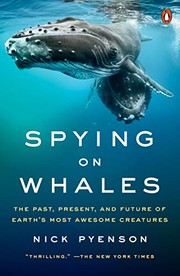
Start with Spying on whales. Nick Pyenson is a working palaeontologist and his 2018 book, 336 pages, is about the fossil record of the land-to-sea transition, written as fieldwork rather than as summary — which means you also learn what the fossils cannot settle. That is the right first lesson in a subject where confident claims routinely outrun the evidence.
The reason this list is ordered at all is that books about cetaceans come in three kinds that bookshops shelve together and readers should not read together. There is popular natural history, which is where nearly all the good writing is. There are field guides, which are reference works you consult at the rail of a boat and never read through. And there is the marine mammal science, which is technical, expensive, and written for people who already have some biology. This path keeps them apart and says which is which.
The narrative books
After Pyenson, read Philip Hoare. Leviathan, or, The whale is the literary heart of the subject — Hoare on Moby-Dick, on Nantucket, and on his own obsession with the animals — and the book most likely to make you care. One warning about the record: it was published as Leviathan in Britain and as The Whale in the United States, and our catalogue holds a single entry under the display title above. One book, three names. Do not buy it twice.
Fathoms is the modern successor and the harder read: Rebecca Giggs starts at a beached humpback and works outward into plastics, ocean noise and the industrial sea. Take it after Hoare for the contemporary conservation picture the older books predate.
Then two books about the hunt. In the Heart of the Sea is Nathaniel Philbrick on the Essex disaster, and it is here because whaling is not background to cetacean biology — the populations biologists study are the ones that survived it. Among whales is by Roger Payne, the biologist who identified humpback song and released the recording that changed public opinion about whaling. Part memoir, part science, and the natural bridge into the research stage, since almost every modern question descends from Payne's observation that the song changes.
The field guides: consult, do not read
These two are reference works and belong in a bag, not on a bedside table. Whales, Dolphins, and Porpoises (Smithsonian Handbooks) is Mark Carwardine's illustrated identification guide, organised species by species with at-sea features and range maps. He has produced several guides under near-identical titles; ours is the Smithsonian Handbooks edition, and any current Carwardine does the same job.
Marine mammals of the world, by Thomas Jefferson, Marc Webber and Robert Pitman, is the more technical of the two at 592 pages — better on skulls and strandings, and the one researchers tend to carry. Use them together rather than choosing between them.
The science
Return to the sea is Annalisa Berta writing for general readers in 223 pages, and it is the right first technical book because it treats whales, seals and sirenians together, which is what makes the convergent solutions visible. Marine mammals is the textbook version by Berta, James Sumich and Kit Kovacs — systematics, functional anatomy, physiology, ecology, 560 pages — and our record is an earlier edition of a book since revised. Biology of Marine Mammals, edited by John Reynolds, is the complementary multi-author volume and is stronger on physiology and the senses; use it for depth on one system once Berta has drawn the map.
Culture and cognition, the contested end
Sperm Whales is Hal Whitehead's monograph on the species he followed for decades, and the best demonstration anywhere of what cetacean fieldwork actually costs in photo-identification, acoustics and statistics. Read it before the argument, not after.
The cultural lives of whales and dolphins, by Whitehead and Luke Rendell, is that argument: song traditions that spread, feeding techniques that pass between individuals, sperm whale clans with distinct dialects. Follow it immediately with Deep thinkers, the edited volume Janet Mann fronts, in which specialists on brain anatomy, cognition and behaviour assess the same claims more sceptically and are explicit about where the data run out. The two belong together, not weeks apart.
Encyclopedia of Marine Mammals closes the list as the reference the whole field defers to, with signed entries by species and topic; ours is an early edition of a work since much expanded. You do not read it, you follow citations into it.
The whole sequence, with lengths and a goal for each stage, is laid out on our whales and dolphins reading path.