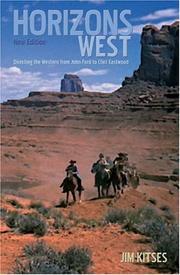
Start with Jim Kitses's Horizons West, the founding structuralist account and the source of the wilderness-versus-civilisation oppositions every later critic argues with. Kitses reads Ford, Mann, Boetticher and Peckinpah as auteurs working the same set of antinomies, and he gives you the vocabulary the rest of this list assumes.
The literature on the Western divides cleanly into people explaining how the genre works and people arguing about what it is doing to its audience, and reading them in that order matters: the interpretive arguments are much harder to assess if you cannot yet place a film in the genre's chronology. So this list runs grammar, then the big claims, then Ford and the silent era, then the revisionist turn and the question of erasure, then the Italians.
The genre's grammar
Edward Buscombe's The BFI companion to the western is the reference volume — historical entries, filmographies, studio and star histories, essays on each period. Do not read it through; check it every time a name, cycle or studio surfaces in another book. Then Ride, boldly ride, Mary Lea Bandy and Kevin Stoehr's chronological survey from the silents to the twenty-first century, and the best single overview of what the genre has actually contained. It comes third, once Kitses has given you a way of sorting the films.
What the Western is really doing
Jane Tompkins's West of Everything reads the Western as a reaction against nineteenth-century women's sentimental fiction — a genre built on silence, pain, landscape and the refusal to feel. It is the most disorienting book here and the one that permanently changes how you watch a saloon scene.
Richard Slotkin's Gunfighter Nation is the third volume of his frontier-myth trilogy, after Regeneration Through Violence and The Fatal Environment, and the only one that deals directly with twentieth-century film and politics. At 850 pages it is the longest thing on this list, and it stands on its own — if you read one volume of the trilogy, read this one, because it is the one about the movies.
John Cawelti's The six-gun mystique is the counterposition and it is only 138 pages: formula criticism treating the Western as a popular ritual with a stable structure, which is the cleanest alternative to Tompkins and Slotkin. Cawelti later revised the argument in The Six-Gun Mystique Sequel, which is not in our catalogue. Reading these three together is the point of the stage — you should finish able to say which of them a given film supports.
Ford, and where the iconography came from
Scott Simmon's The invention of the western film is the most surprising history on this list, showing the genre's conventions being assembled in the silent era, including a strand of early Westerns sympathetic to Native characters that the sound era abandoned. Read it before the Ford books, not after.
Joseph McBride's Searching for John Ford is the major biography at 859 pages, and unusually good at separating Ford's self-mythology from the record — the Irish background, the studio politics, the contradictions in how he treated Native subjects. Scott Eyman's Print the Legend covers the same life if you want a second account; it is not on this path. Glenn Frankel's The searchers then traces one film back to the 1836 abduction of Cynthia Ann Parker and forward through Alan Le May's novel to Ford's production — the clearest demonstration here of how a Western converts a historical atrocity into myth.
The revisionist turn and who gets erased
Frankel's High noon reads the blacklist through one production: Carl Foreman writing the screenplay while being subpoenaed, and the film becoming an allegory nobody could state out loud. W. K. Stratton's The Wild Bunch is a production history of the film that ended the classical Western — Peckinpah's violence, the Mexican location shooting, the ratings fight it provoked.
Hollywood's Indian, edited by Peter Rollins and John O'Connor, is an essay collection on the portrayal of Native Americans in film, including the sympathetic revisionist Westerns and their own problems. It is the necessary corrective to a list that has otherwise been about white protagonists, and it belongs in the sequence rather than as an appendix to it.
The Italians
Christopher Frayling's Spaghetti Westerns remains the only serious book-length study in English: the Italian film industry, the economics of Cinecittà and Almería, the left-wing politics under the violence, and the specific American conventions being parodied. Close with Frayling's biography of Leone — our catalogue displays it simply as Sergio Leone, though it is published as Sergio Leone: Something to Do with Death — built on years of interviews with the director and tracing a career from a childhood watching American Westerns in Fascist Rome to remaking the genre for everyone who came after. Stage goals and the reading schedule for each stage are at /paths/pt_ai_western-movies.