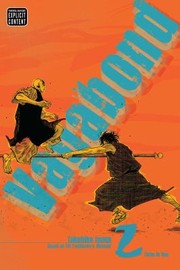
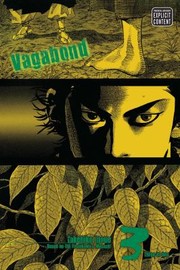
Start with Vagabond VIZBIG Edition, Vol. 1 and read the twelve VIZBIG volumes in number order. Vagabond exists in English in two incompatible numbering schemes, and this is the one to use: each VIZBIG collects three of the original volumes, so twelve books hold the entire available run in one consistent format. Our record for the first is 728 pages — that is not a weekend, and it is the single most useful thing to know before you buy.
That page count is also the reason a naive comparison misleads. A 600-page VIZBIG is not a long book, it is three books, and the middle of this series is drawn at a pace that punishes hurrying. Takehiko Inoue is adapting Eiji Yoshikawa's serialised novel about Miyamoto Musashi, and much of what makes the adaptation famous happens in silence.
Takezo becomes Musashi: volumes 1 to 3
Volume one covers Takezo surviving the battlefield at Sekigahara, the hunt through his home village, and the monk Takuan who renames him — considerably more ground than a single-volume start would give you. Vagabond VIZBIG Edition, Vol. 2 puts Musashi on the road and stages the first Yoshioka encounters, which set up the feud that structures the entire middle of the series; it reads as one continuous movement with the first. Vagabond VIZBIG Edition, Vol. 3 introduces Sasaki Kojiro's childhood in parallel with Musashi's rise. That double narrative is the structural gamble the whole series rests on, so if it works for you here, the remaining nine volumes will too.
The Yoshioka school: volumes 4 to 6
Vagabond VIZBIG Edition, Vol. 4 brings the Hozoin spear temple and the Inshun duel, the first fight Inoue draws as a study in stillness rather than motion, and the pacing rules for everything after are set here. Vagabond VIZBIG Edition, Vol. 5 is the Yagyu sequence and the encounter with Sekishusai that quietly ends Musashi's belief that winning is the point. Vagabond VIZBIG Edition, Vol. 6 escalates the Yoshioka feud toward the schoolyard duel, and it is the volume where the brush takes over from the pen completely. Read that one in daylight, slowly.
Ichijoji and after: volumes 7 to 9
Vagabond VIZBIG Edition, Vol. 7 is the approach to Ichijoji — seventy men against one, drawn across hundreds of near-wordless pages. It is the most technically extraordinary stretch of the series and the place where readers most often try to speed up, which is exactly backwards; there is almost no dialogue to carry you, so the drawing has to be looked at rather than read past. Vagabond VIZBIG Edition, Vol. 8 is the aftermath and the physical and mental collapse that follows, where the book stops being an action comic and never fully returns. Vagabond VIZBIG Edition, Vol. 9 brings Kojiro's parallel life fully forward, and it is essential before the farming arc, which otherwise reads as a digression.
The farm, and where it stops: volumes 10 to 12
Vagabond (VIZBIG Edition), Vol. 10 — the parenthesis is a quirk of our record, not a different book — is Musashi in a village, learning to farm. Readers who abandon Vagabond usually abandon it here; readers who love it usually love it because of here. Vagabond VIZBIG Edition, Vol. 11 resolves that arc and returns to the road, with Inoue's interest in bodies at work rather than bodies fighting at its clearest. Vagabond VIZBIG Edition, Vol. 12 is the last collected volume and the end of what exists in English.
Say this plainly, because it changes how you read: Vagabond is unfinished. It has been on hiatus for years and does not reach the duel at Ganryujima that the entire series has been pointing at. Knowing that in advance makes volume twelve a stopping point rather than a disappointment.
The novel underneath
Musashi is Yoshikawa's 1930s serialised novel, 977 pages in our record, and the direct source Inoue is adapting. It does reach the duel with Kojiro. Read it after the twelve volumes, when you want an ending — and read it as its own thing, since Inoue invents freely and the two diverge more than an adaptation credit suggests.
The staged version is on the Vagabond reading path.