Start with A Vindication of the rights of woman, 287 pages, which is angrier and funnier than its reputation as a classic suggests and stands entirely on its own. It is the book you came for, and the argument is compact: women are not naturally frivolous, they are educated into frivolity, and that makes their position a political question rather than a natural fact. Nothing on this path needs prior background.
Before you buy anything, one edition note. Our record for the earlier pamphlet, A vindication of the rights of men ; with, A vindication of the rights of woman, and Hints, is the combined Cambridge edition, 349 pages, which prints both Vindications and the Hints in one volume. This path ships both records, but they are one book — buy the combined edition or the standalone Rights of Woman, not both. The pamphlet itself was the first published reply to Burke's Reflections on the Revolution in France, written in weeks and printed anonymously, and it argues that inherited property and inherited deference corrupt sympathy itself.
Before the Vindications
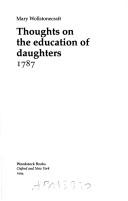
Education was her subject from the beginning, not a conclusion she reached. Thoughts on the Education of Daughters, 170 pages, was her first book, written at twenty-seven out of direct experience of running a school; it is conventional in places and startling in others. Mary, A Fiction is a short autobiographical novel about a woman of feeling trapped in a loveless marriage — our record carries no page count — and it is worth reading for the argument it dramatises rather than as a novel. Original stories from real life, 176 pages of moral tales later illustrated by William Blake, teaches reason and self-command rather than obedience, and shows the educational programme written for actual children.
The Revolution, Scandinavia and the unfinished novel
An historical and moral view of the origin and progress of the French Revolution — our record holds it under the full original title, which continues and the effect it has produced in Europe — is 522 pages written in France while acquaintances were being guillotined, and a serious attempt to defend the Revolution's principles while accounting for its violence. It is the book most readers abandon, and the reason is not the page count so much as the register: it is sustained political history by a writer whose gift was polemic and observation.
Which is exactly what makes Letters written during a short residence in Sweden, Norway, and Denmark the surprise of the path. At 218 pages it is travel writing that is also a record of heartbreak, written on a commercial errand for a lover who was betraying her, and Godwin said it was calculated to make a man fall in love with its author. Most readers end up rating it her best prose. Maria; or, The Wrongs of Woman, 157 pages and unfinished at her death, extends the argument from education to marriage law, custody and sexual desire, and goes further than the Vindication did.
The scandal, and the books that undo it
Memoirs of the author of A vindication of the rights of woman, 206 pages, was written by her husband months after she died in childbirth and intended as a tribute; its unguarded honesty about her illegitimate child, her suicide attempts and her affairs became the weapon used to discredit the arguments for a century. Read it first here, as a document and as a lesson in how reputations are made.
Then the biographies, where length is a poor guide to effort. Claire Tomalin's The life and death of Mary Wollstonecraft, 316 pages, is the 1974 book that put her back into general circulation and is still the best single-volume life. Charlotte Gordon's Romantic outlaws, 649 pages, alternates chapters between Wollstonecraft and her daughter Mary Shelley, who never knew her, and reads faster than either shorter book because the structure carries you. Lyndall Gordon's Vindication, 576 pages, is written explicitly against reading her life as a series of romantic disasters.
Two books you may expect and will not find here. Janet Todd's 1976 Wollstonecraft volume is an annotated bibliography rather than her 2000 biography, so it was dropped. Barbara Taylor's Mary Wollstonecraft and the Feminist Imagination exists and is well regarded, but its catalogue record credits Barbara Taylor Bradford, a different and very famous novelist, so we do not stock it.
Close with The Cambridge companion to Mary Wollstonecraft, 296 pages of specialist essays on the political theory, the fiction, her religious thought and two centuries of contested reception. The ordered Wollstonecraft path sets all of this out in stages with a study plan for each.