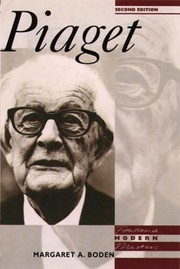
Start with The Psychology of the child, 173 pages, the short synthesis Piaget wrote with Inhelder covering forty years of work. It is the most efficient statement of the whole theory in his own words — assimilation and accommodation, schemes, equilibration, the stages — and everything else is either the evidence behind it or an argument with it. Pair it with Margaret Boden's Piaget, 174 pages, a cognitive scientist's compact critical introduction that takes the epistemology seriously instead of reducing him to a timetable. Its record carries translators in the author field.
Say the important thing before the reading list rather than after it. The stage theory should not be presented as current developmental science. Later work using looking-time and simplified tasks found infants showing object permanence and numerical sensitivity considerably earlier than his reaching tasks implied; conservation failures turned out to depend heavily on how the question is asked; and domain-general stages have largely given way to domain-specific accounts and to overlapping-waves models of change. What survived is the constructivist core — that children build understanding through their own activity — and the phenomena themselves, which are real and replicable. Read him for those, and for the questions, not for the schedule.
The clinical studies
Language and Thought of the Child, 312 pages, is his 1923 debut and the origin of egocentric speech; Vygotsky's Thought and Language is the famous contemporaneous rebuttal on exactly that point. The child's conception of the world, 397 pages, interviews children on dreams, names, life and the movement of clouds, and shows what an open-ended interview finds that a standardised test cannot. Moral Judgment of the Child, 435 pages, gave Kohlberg his whole research programme and, by reaction, Carol Gilligan her critique of it. The method is enormously productive at generating phenomena and weak at establishing frequencies, which is where most of the later criticism starts.
Infancy, the part that held up
The origin of intelligence in the child, 419 pages, is day-by-day observation of his own three children building the sensorimotor stages from reflexes to means-end behaviour. The construction of reality in the child, 386 pages, shares that data and covers object permanence and the A-not-B error in their original form. Play, dreams, and imitation in childhood, 296 pages, completes the trilogy on symbolic function.
Where page count lies
Genetic epistemology is 84 pages, the shortest book on the path and the densest thing on it — four lectures stating what the whole enterprise was for, which is a biological and historical account of how knowledge grows. By contrast The origin of intelligence in the child is 419 pages that are easy sentence by sentence and exhausting in bulk, because they are observation notes. Budget by kind of book, not by length.
Two cataloguing notes. The Child"s Conception of Numbers holds the conservation experiments — the two rows of counters, the tall and short glasses — but our record has a mangled display title with a stray quotation mark and a pluralised Numbers, and no page count; the work is his 1941 study. And The growth of logical thinking from childhood to adolescence, 356 pages, is credited on our record to Barbel Inhelder alone, with Piaget absent from it. Inhelder designed most of those experiments, so the credit is arguably fairer than the usual attribution, but it does mean searching under Piaget may not find the book.
The revision, stated properly
Piaget's Construction of the Child's Reality, 262 pages, is a close audit asking whether his own observations support his conclusions, and it is the most rigorous critique here. The Scientist in the Crib, 292 pages by Gopnik, Meltzoff and Kuhl, is popular science and openly enthusiastic about its own programme — read it as the case for the prosecution. Then Children's thinking, 429 pages, is the standard developmental textbook and the fairest place to see where the field actually settled.
The staged Piaget reading path keeps that final stage compulsory rather than optional, for the reason above.