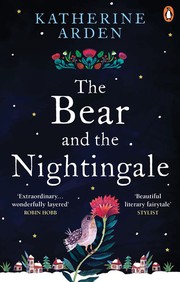
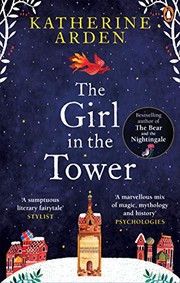
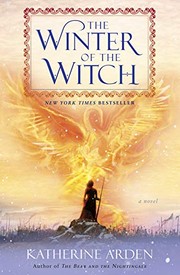
Start with The Bear and the Nightingale. Katherine Arden's trilogy has the simplest reading order in modern fantasy and the least forgiving one: three novels, publication order, no prequels, no side stories, and no alternative way in. Each volume opens on the exact consequence of the one before it.
The trap is that the first book does not announce itself as the first third of anything. It reads like a self-contained folk novel with a complete ending, which is why a large number of readers stop there and never learn that the ending is a setup. If you finish it and feel satisfied, that is the design working, and it is also the moment to pick up the second book rather than shelving the series.
The trilogy, in order
The Bear and the Nightingale (368 pages) puts a girl in a fourteenth-century village north of Moscow who can still see the household spirits everyone else has stopped feeding, at the moment a new priest arrives to stamp them out.
The Girl in The Tower (392 pages) opens days after the first book closes and moves the story from the forest to the politics of Moscow, with Vasya disguised as a boy among the Grand Prince's men. The change of register is deliberate and it puts some readers off; the folklore has not gone anywhere, it has moved into a city.
The Winter of the Witch (384 pages) runs from a riot in Moscow to the battle of Kulikovo and resolves the bargain between Vasya, Morozko and the Bear. Read it close to the second book, because it assumes you remember every debt owed in that one.
The folklore Arden is retelling
This is the genuinely useful companion reading, and it is short. Knowing a domovoi from a vazila changes what the novels feel like.
Russian Fairy Tales is the source collection — Russia's equivalent of the Grimms — and the direct ancestor of the trilogy, with Morozko, Vasilisa and the firebird each present in a few pages. Read a handful before the second novel and you will start to see which turns Arden follows and which she reverses.
Baba Yaga (368 pages) is a full scholarly study by Andreas Johns of the ambiguous witch of the Slavic tales, helper as often as devourer — which is the reading Arden takes. It is an academic monograph and it wants you to have several versions of the tales in your head already, so come to it after the collection rather than before.
The Bathhouse at Midnight (504 pages) is W. F. Ryan's standard survey of magic and divination in Russia, and it explains the trilogy's central tension: not paganism against Christianity but a long coexistence of both. It is a reference work, not a narrative, and reads like one.
The Rus the novels are set in
Medieval Russia, 980-1584 (456 pages) is Janet Martin's standard one-volume history of exactly this period, including the Mongol tribute system and Dmitrii Donskoi's Moscow. Read it after the novels: it turns the political background Arden keeps in the corner of the frame into the foreground. The icon and the axe (786 pages) is James Billington's sweeping interpretive history of Russian culture — much longer, much more argumentative, and the classic account of how Orthodox Christianity and older popular belief settled into one another. Take it as the interpretation laid over Martin's facts.
The novels next door
Deathless (352 pages) relocates Koschei the Deathless to the Leningrad of the purges and the siege — the same source material taken in the opposite direction, denser and far stranger in its prose. Uprooted (438 pages) is Polish rather than Russian folklore and the standalone most often recommended to Winternight readers; it is the tighter of Naomi Novik's two, so start there. Spinning Silver (473 pages) is Rumpelstiltskin crossed with a winter court across three narrators, structurally the more ambitious, and it asks more of you. The Snow Child (432 pages) transplants the Snegurochka tale to 1920s Alaska with the magic left genuinely undecided, and shows how little machinery a folk tale actually needs.
Arden's other books
Small spaces (224 pages) is her middle-grade horror novel and the first of a quartet — a school bus, a fog, and scarecrows. It is much shorter and much scarier than Winternight. Warm Hands of Ghosts (432 pages) is her first adult novel after the trilogy, following a combat nurse looking for her brother on the Western Front in 1918, with one supernatural element held at arm's length.
Where to stop
After The Winter of the Witch, which is a real ending and not a pause. Everything else on this path is companion reading rather than continuation. The full ordered path is at the Winternight trilogy reading path.