The Pacific war punishes readers who start with the famous battles. Midway, Guadalcanal, Iwo Jima and Okinawa are all comprehensible only against a map most people do not carry, and against a strategic argument — two axes of advance, an island-hopping logic, a submarine campaign that strangled Japanese shipping — that the battle narratives assume rather than explain. The theatre is also the one where the war's ending is still genuinely disputed among historians, which is a bad thing to walk into unprepared.
So the order below settles the geography and the chronology first, reads the modern narrative spine straight through, then goes close-up on the sea and the ground, and saves the two hardest questions for last.
The whole theatre at once
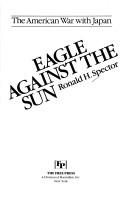
Eagle against the sun is the standard single-volume American history of the war against Japan, and it covers strategy, logistics and inter-service politics as well as the fighting. Read it first. Everything after this assumes you know where Truk and Tarawa are and why they mattered.
The narrative spine
Ian Toll's three volumes are the fullest recent account, and they give the Japanese side genuine weight rather than treating it as scenery. Read them in order.
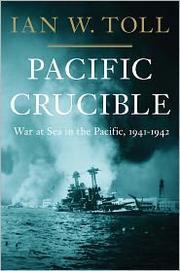
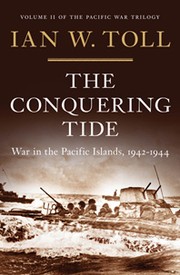
Pacific Crucible covers 1941 to Midway, with long attention to the pre-war naval rivalry and to Japanese decision-making. The conquering tide takes Guadalcanal, the Solomons and the central Pacific drive to the Marianas — the phase where American industrial output becomes decisive, and the least familiar stretch of the war. Twilight of the Gods covers Leyte Gulf, the kamikaze campaign, Iwo Jima, Okinawa and the endgame, and it sets up the arguments in the final stage, so do not read it out of sequence.
Two battles in operational detail
Shattered sword reconstructs Midway from Japanese sources and dismantles the famous five-minutes story along with much else that Mitsuo Fuchida's postwar account put into circulation. It is the best demonstration on this path of what happens when historians go to the other side's records, and it will make you sceptical of anything you learned about Midway before it.
Neptune's Inferno follows naturally: same year, same ocean, no air cover. The surface naval battles off Guadalcanal were the bloodiest sustained fighting the US Navy has ever done, and they are routinely skipped in favour of the carrier actions.
The infantry's war
With the old breed, at Peleliu and Okinawa is widely regarded as the finest combat memoir of the Second World War — a Marine mortarman writing plainly about two of its worst battles, with no interest in glory. Read it before Leckie.
Helmet for My Pillow covers Guadalcanal, New Britain and Peleliu from another Marine in the same division, funnier and more literary, and covering the earlier campaigns. Together the two span the whole Marine war.
The hardest questions
War without mercy is the classic study of race and propaganda on both sides, and of how each combatant dehumanised the other. Read it first in this stage: it accounts for behaviour the operational histories describe without explaining.
Retribution covers the final year across the whole theatre, including China and Burma, and is unsparing about Allied as well as Japanese conduct. Hastings makes strong judgements and expects to be argued with.
Then the central controversy, which this path deliberately leaves open. Downfall is the most detailed reconstruction of the invasion planning and the Japanese decision to surrender, and it makes the strongest scholarly case that the atomic bombs were militarily decisive. Racing the enemy uses Japanese, Soviet and American sources to argue that the Soviet declaration of war weighed at least as heavily in Tokyo's calculation. Read them consecutively. Both authors are serious historians working from the archives, they disagree, and the disagreement is the most honest thing this reading list can hand you.
The staged version with study plans is on the full path; see also the Pacific war hub.
Follow the full ordered path here: Best Books on the War in the Pacific, in Reading Order.