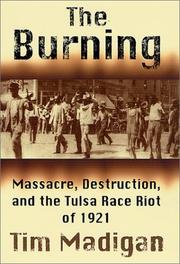
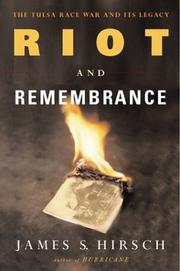
Tim Madigan's The Burning is the fastest way to acquire the sequence of events — the most vivid reconstruction of 31 May and 1 June 1921, built on survivor testimony. Follow it with Randy Krehbiel's Tulsa 1921, a Tulsa newspaperman's account of the press, including his own paper's part in the incitement and the missing front page of the Tribune; it corrects several details of the popular narrative. James S. Hirsch's Riot and Remembrance then covers the massacre and the eighty years after it, which makes it the first book here to show the event and its afterlife as one continuous story.
A white mob, deputised by city officials and joined by aircraft dropping incendiaries, destroyed thirty-five blocks of the most prosperous Black commercial district in the United States. The books give a death toll ranging from thirty-nine to several hundred; the range is a finding, not an evasion. Then the event was removed from Oklahoma's public memory for over fifty years — absent from state histories, absent from the schools.
What was destroyed, and who wrote it down first
Hannibal B. Johnson's Black Wall Street is Greenwood as a community rather than a crime scene: the businesses, churches, newspapers and the people who built them. Without it the massacre reads as an event without a subject. His Acres of aspiration widens the frame to African Americans in Oklahoma generally — the all-Black towns, the promise of the territory, and what statehood and Jim Crow did to it — establishing that Greenwood was not an anomaly but the largest example of something.
Between them sits the primary source. Mary E. Jones Parrish's The Nation Must Awake is the first account ever written: a Greenwood survivor who collected eyewitness testimony from her neighbours within months, self-published it, and then saw it effectively lost for decades. This modern edition adds essays by her great-granddaughter and by historians. It is also catalogued separately under its original title, Events of the Tulsa Disaster; that is the same text, so buy one.
Why the word is the whole argument
This is the organising idea of the third stage, and it is not a matter of preferred vocabulary. Insurance policies of the period excluded riot damage. Classifying the destruction as a riot therefore voided Greenwood's rebuilding claims almost without exception. Framing an organised, officially deputised attack as a spontaneous disturbance also shaped who could be charged, and no white participant was ever successfully prosecuted. The shift to massacre is recent, was contested, and was formally adopted by the state commission and then by Oklahoma.
Which is why the older books are kept here rather than filtered out. Alfred L. Brophy's Reconstructing the Dreamland: The Tulsa Riot of 1921 is the legal history — the deputisation of the mob, the insurance exclusions, the litigation that failed, the case for reparations — and it is the book where the naming question is most usefully joined, since Brophy argues explicitly about what the event should be called while his own subtitle carries the older word. Madigan's subtitle does the same. Scott Ellsworth's Death in a Promised Land is the study that recovered the massacre for scholarship after six decades of near-total silence, and everything since rests on it; read it twice, once as a history of 1921 and once as evidence of where the historiography stood before the commission. Sherrilyn A. Ifill's On the Courthouse Lawn is not about Tulsa: it is the general argument about how American communities live with unprosecuted racial violence, and what repair might mean.
The graves, and the century after
Ellsworth's The Ground Breaking is the current account, returning to the subject decades later for the search for the mass graves — the oral history that pointed to Oaklawn Cemetery, the ground-penetrating radar, the politics of getting permission to dig. The excavation work involves the exhumation and forensic examination of human remains; it has recovered burials and has not, so far, produced a count. Victor Luckerson's Built from the Fire tells a century of Greenwood through one family, running well past 1921 into urban renewal and the highway that finished what the mob started; we hold no page count for it, so plan it as a full-length narrative history. Cameron McWhirter's Red summer goes last, on the wave of white attacks on Black communities across the United States two years earlier, establishing that Greenwood was the largest instance of a national pattern.
The ordered path with study plans is at /paths/pt_ai_the-tulsa-race-massacre.
Ready to learn something deeply?
Build a reading path — free