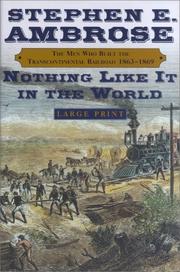
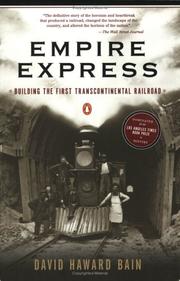
If you read one book here, read David Haward Bain's Empire Express — 797 pages, the serious single-volume history, far better sourced than anything else on the subject and equally good on the engineering and on the lobbying. If you want a faster way in first, Stephen E. Ambrose's Nothing Like It In The World is the readable popular narrative, though it has been criticised both for factual errors and for unqualified admiration of the builders, so take it as an introduction whose judgements the later books will correct.
The line completed at Promontory Summit in May 1869 is the standard American story of engineering triumph, and it is a good story. What that version omits is most of the interesting part: who actually built it, who paid for it, and what it cost the people whose territory it crossed. The order below takes the triumphal narrative first because you need the events, then the workers, then the money, then the cost.
The construction narrative
John Hoyt Williams's A Great and Shining Road is tighter than Bain and strong on the physical construction and on the race between the two companies — a reasonable substitute if Bain is more than you want, though not an equal one. Walter R. Borneman's Iron Horses is read for one thing: it keeps the Civil War context in view, which most treatments drop, so take it for the political timing rather than for new material. Between them you should finish able to explain the Pacific Railway Acts, who the Big Four and the Union Pacific principals were, and what the Sierra Nevada crossing required.
The workers, who are not a footnote
The Central Pacific's workforce was overwhelmingly Chinese, and its members are almost entirely absent from the written record. Gordon H. Chang's Ghosts of Gold Mountain is the book that changed this subject: he reconstructs their lives from payroll records, archaeology and Chinese-language sources, because almost nothing the workers themselves wrote survives. That absence is the book's method and its subject at once. It covers the deaths from avalanche, explosives and exposure, and the violence directed at Chinese communities after the line was finished.
Its scholarly companion, The Chinese and the Iron Road, edited by Chang with Shelley Fisher Fishkin, collects the underlying research. Read it selectively, as a reference rather than end to end. Together these two are a stage about evidence — about what it means to write the history of people who left payroll lines and grave sites rather than letters, and about the fact that the workforce which did the most dangerous work is precisely the part of the standard story that vanished.
The money, and the argument about whether it was worth it
Maury Klein's Union Pacific is the standard corporate history and the necessary groundwork; Klein is more sympathetic to the builders than what follows, which is exactly why he comes first. Richard White's Railroaded is the central revisionist work: the transcontinentals as poorly run, politically sustained enterprises that destroyed capital and corrupted government, built decades before there was traffic to justify them. Read it as an argument with a case rather than as settled fact, and read Klein first so that White is arguing against a version you actually hold.
Robert William Fogel's Railroads and American economic growth is the shortest book in this stretch and comfortably the hardest — econometric history, a counterfactual estimate of what American growth would have looked like without railroads, and contested on method ever since. It is the origin of the question White is answering, so do not skip it for being short. White's Oxford History volume The republic for which it stands goes last, placing the railroads inside the political economy that produced them.
The cost, and what came after
Peter Cozzens's The Earth is weeping covers the Indian wars of the trans-Mississippi West with testimony from both sides, over exactly the period and territory the railroad opened; it is the most direct account of what the line cost the nations it ran through, and it deals throughout with massacres of civilians. Walter R. Borneman's Rival Rails follows the competition to build the southwestern routes after 1869 — the demonstration that Promontory was a beginning, not an end. We hold no page count for it, so plan it as a full trade history rather than around a figure we cannot supply. Christian Wolmar's The great railroad revolution closes the list, putting one celebrated line in proportion against a far larger eastern network.
The full ordered path is at /paths/pt_ai_the-transcontinental-railroad.