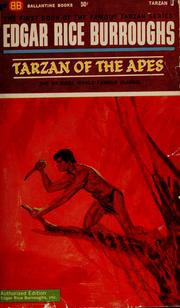
Start with Tarzan of the Apes, the 1912 original, and read the first four in order. Edgar Rice Burroughs wrote twenty-four Tarzan novels between 1912 and 1947, and almost nobody should read all of them — but the first four are a genuinely continuous story, and after that the series becomes episodic, each book a self-contained expedition to a lost city with no bearing on the next.
Two things worth knowing before you open the first book. The novels bear almost no resemblance to any film: Burroughs's Tarzan teaches himself to read from his dead parents' primers without knowing how any of it sounds, learns to speak French before English, and spends most of the series as a literate English peer. And the books contain sustained racial characterisation of Africans — hierarchies of civilisation, physical description used as moral shorthand, whole plots built on them. It is central to the texts rather than an occasional lapse, it is heaviest in the 1910s and 1920s volumes, and there is no edition that removes it. That is a fact about what you will be reading.
All of these are public domain, so the early novels are freely and legitimately available from Project Gutenberg. Our records point at specific mid-century paperback printings rather than reprint scans, which is why several display titles carry their edition tags — an Ace number here, a Ballantine number there.
The first four, in order
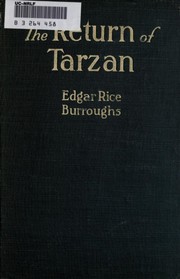
Tarzan of the Apes is the only obligatory volume: marooned parents, the ape Kala, and a boy who teaches himself to read English from picture books. Its ending is famously abrupt, which is what forced the sequel. The Return of Tarzan is the direct continuation — Paris, the Foreign Legion, and the first appearance of the lost city of Opar, which Burroughs returned to for decades. Read it immediately; book one does not conclude without it.
The Beasts of Tarzan (Classic Ace SF, F-203) strands Tarzan on an island where he assembles an army of apes and a panther to recover his kidnapped son, and it is the leanest and most propulsive of the early books. The Son of Tarzan hands the story to Jack, raised in England, who repeats his father's history in his own way. It closes the continuous arc. Everything after is episodic, and stopping here is entirely defensible.
The best of the middle run
Tarzan and the Jewels of Opar returns to Opar and its priestess La, and establishes the lost-city template the rest of the series runs on — the best single demonstration of what Burroughs was actually good at. Jungle Tales of Tarzan is twelve linked stories of his adolescence among the apes, set before the first novel; it is the odd one out and, by a wide margin, the best-written volume in the series. Read it here rather than in chronological position.
Tarzan the Untamed (Book #7) brings the First World War to East Africa and turns Tarzan to methodical revenge. It is the most violent and the most openly propagandistic book of the twenty-four, its portrayal of German troops got it banned in Germany for decades, and it should be read knowing exactly what it is. Tarzan the Terrible (#8) completes it, into the hidden valley of Pal-ul-don with its tailed hominids and living dinosaurs, and commits the series fully to lost worlds.
The lost-city period
Tarzan and the Golden Lion is a third trip to Opar with an impostor plot and the lion Jad-bal-ja, and it is a fair measure of the settled formula. Tarzan and the Ant Men is the strangest book Burroughs wrote about the character — Tarzan shrunk to eighteen inches among a civilisation of tiny people, with a satirical sideswipe at eugenics — and it shows the range the series could still reach in 1924.
The late books, and where to stop
Tarzan at the Earth's Core crosses over into Pellucidar, Burroughs's hollow-earth setting, reached by dirigible; it is the most enjoyable of the later run precisely because it abandons Africa. Tarzan And The Foreign Legion (Ballantine 23859, #22) is the last Tarzan novel Burroughs published, written while he was a war correspondent in the Pacific and set in Japanese-occupied Sumatra. It is the natural endpoint: a 1912 character who can no longer be made to fit the century he has arrived in.
Our records cover twelve of the twenty-four novels, so the remaining lost-city volumes of the 1930s are not listed here. Most readers find they are interchangeable, which is the honest reason not to chase them.
Around the novels
Tarzan forever by John Taliaferro is the standard biography — a failed pencil-sharpener salesman at thirty-five who invented one of the most licensed characters on earth and largely lost control of it. A Princess of Mars was written the same year as the first Tarzan and founded planetary romance; read the two together and you have most of twentieth-century adventure pulp in embryo. The full ordered sequence is on the Tarzan reading path.