Professional sport is one of the few industries in which the firms need their competitors to survive, which is why almost nothing in ordinary industrial economics transfers cleanly. A league is a cartel that arguably has to be one; the product is uncertainty of outcome; the labour market runs on drafts and caps that would be illegal in most sectors. Get that apparatus first and the rest of this reading becomes an application of it.
Then follow the money to the three places it is most contested: publicly financed stadiums, unpaid American college athletes, and the broadcast rights that now dwarf ticket revenue on both sides of the Atlantic.
The economics of a league
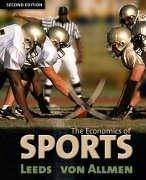
Sports economics is the standard textbook, built around North American leagues and unusually clear on the gap between what owners claim and what the accounting shows. One practical warning: our record is an early edition of a book that has been revised repeatedly, so buy the current edition if you want the figures rather than the framework.
The economics of sports covers the same ground with more formal microeconomics and more attention to college sport and stadium finance. Read it alongside the previous book rather than after it — where the two differ in emphasis, you are seeing the shape of the discipline. Our record duplicates the lead author's name in two spellings, which is a catalogue artefact rather than two people; it is Michael Leeds with Peter von Allmen.
Money inside the club
Sports Finance and Management is the one book here that treats a team as a firm with a balance sheet: franchise valuation, capital structure, and the accounting of a sports business. Reach for it when you want mechanics rather than argument.
Playbooks and Checkbooks is short and elegant, and it is the best bridge between the American and European halves of this subject. Szymanski compares the closed North American league with promotion and relegation, and explains why each structure produces a different financial pathology — one tending to protected profits, the other to persistent losses.
Who pays for the stadium
This is the most one-sided empirical result in the field: economists across the political spectrum find that publicly subsidised stadiums do not generate the local growth used to justify them, and cities keep building them anyway. Field of schemes is the investigative account of how teams extract public money by threatening to leave, told deal by deal, and it belongs first because it shows the mechanism before the regressions arrive. Our record lists the co-author under two spellings; it is Joanna Cagan with Neil deMause.
Public dollars, private stadiums asks the better question — why the subsidies keep passing when the economic case is so weak — and answers it with local growth coalitions rather than with economics. Then Circus Maximus applies the same analysis to Olympic Games and World Cups, where the sums are larger and the accountability weaker.
The unpaid workforce
American college sport is a multibillion-dollar industry that until recently paid its athletes nothing. Billion-dollar ball is reported from inside major college football programmes: the television money, the facilities arms race, and the accounting that lets an athletic department claim to lose money. Unpaid Professionals is the economist's version of the same case, made in 1999 and largely vindicated — amateurism as cost suppression rather than educational principle.
Indentured follows the litigation that broke the NCAA's amateurism defence, case by case, and is the right closer because it is about how the arrangement started to end. Our record for it also doubles the lead author's name in two spellings; it is Joe Nocera with Ben Strauss. Read all three knowing the legal position has changed substantially since they were written — name, image and likeness rules have undone part of what they describe — which is precisely why the argument in them is worth having.
Leagues, media and power
Finish on the revenue that now dominates everything else. The game is the commissioner-level history of Major League Baseball from the 1994 strike through the steroid era, and the best narrative available of how a league's business is actually governed. Big game is a political reporter's year inside the National Football League's ownership class — the portrait of the people buying and selling those broadcast rights.
Two on European football to finish. Club is our catalogue's bare display title for Clegg and Robinson's account of how England's top division was deliberately broken away in 1992 and turned into a global media product. Money and soccer is Szymanski's technical companion to it: why clubs lose money persistently, why relegation makes financial discipline nearly impossible, and what financial fair play was actually for.
If you want the stage goals and reading schedule in order, the path is at /paths/pt_ai_the-sports-business.