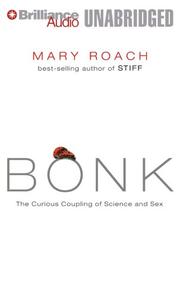
Start with Mary Roach's Bonk. It is a reported history of sex research — Victorian gynaecology, Kinsey's interview army, laboratory imaging, and several experiments Roach volunteered for herself — and it teaches the one thing that makes the rest of this path legible: how difficult this field has always been to fund, staff and publish in. The methodological compromises in every study below are downstream of that.
The second thing to settle early is the difference between a finding and a framework. This is a reading list about what has actually been measured, by whom, on what sample, and where the disagreement is real. Several of these books argue for a conclusion rather than report one, and this guide says which.
Two ways in, and a textbook to check them against
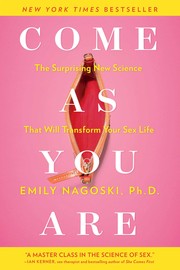
Come as you are is Emily Nagoski's popular statement of the dual-control model — sexual response as accelerator and brakes rather than a single drive — which is a genuine and well-supported research framework. It is also written as applied self-help for women, so it argues as often as it reports; read it as both. Two catalogue warnings on this one: our record is a foreign-edition listing and carries a Spanish translator in the author field, so check the language of any listing before you order.
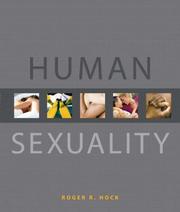
Roger Hock's Human Sexuality is the standard undergraduate textbook, organised around studies rather than opinions, and at 654 pages it is not a cover-to-cover read. Keep it open as the thing you consult when a trade book asserts something confidently.
The founding studies, and how their sampling failed
Kinsey's two volumes are the origin of the subject as something countable. Sexual Behavior in the Human Male appeared in 1948 and Sexual Behavior in the Human Female in 1953; the second was far more socially explosive and cost him his funding. Read the methodology sections rather than skipping to the famous percentages — Kinsey's volunteers were not a random sample of Americans, and his own text shows you why.
James Jones's Alfred C. Kinsey is the critical biography that documented Kinsey's personal involvement in the material he studied and reopened the question of how far his commitments shaped his results. Other Kinsey scholars contest it; take it as one strongly argued case, not the settled record.
Human sexual response is the 1966 laboratory work behind the four-phase response cycle that governed clinical thinking for decades. Our record credits William Masters alone; Virginia Johnson is a co-author of the book and of the research programme. It is clinical and dry, and worth reading because so much later writing paraphrases it without mentioning that the cycle has since been substantially revised.
Counting a population properly
Sex in America is the readable account of the 1992 National Health and Social Life Survey, the first properly sampled national study of American sexual behaviour, whose findings were markedly less dramatic than Kinsey's. Robert Michael is the credited author on our record; Gagnon, Laumann and Kolata wrote it with him, and the full scientific report was published separately as The Social Organization of Sexuality, which is not in our catalogue.
Justin Lehmiller's Tell me what you want reports his own large survey of sexual fantasy. The sample is self-selected and online, which Lehmiller states plainly — read it as a map of variation, not of prevalence.
The evolutionary argument, and the replies
David Buss's The Evolution of Desire is the standard evolutionary-psychology account of mating, built on his survey across thirty-seven cultures. Read it first, because the next two books are answers to it. Sex at Dawn is the best-known popular counter-argument, claiming prehistoric human sexuality was promiscuous and monogamy an agricultural artefact; it is openly polemical and has been heavily criticised by anthropologists and primatologists for selective use of evidence. It is here because the debate matters, not because the case is made. Note that our record for it carries a Turkish publisher prefix, so check the listing language.
Cordelia Fine's Testosterone rex works through the primary studies behind the testosterone-and-mating-strategy story rather than the popular summaries. It is the most methodologically careful book in this stage and the right one to finish on.
Fluidity, and the politics of doing this work
Lisa Diamond's Sexual fluidity is a ten-year longitudinal study of women's attractions, cautious about its own scope and routinely overstated by people citing it. Galileo's middle finger closes the path with Alice Dreger investigating cases where sex and gender researchers were attacked — sometimes justly, sometimes not. Dreger is a participant in several of those disputes, which she says, and the book has itself been contested; read it as the field arguing about its own conduct.
The full ordered path, with the stage goals and study plans, sits at /paths/pt_ai_the-science-of-sex-and-sexuality.