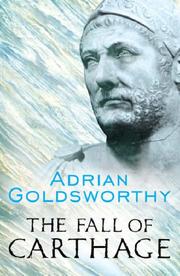
Start with Adrian Goldsworthy's The Fall of Carthage. It covers all three wars in one volume, it is written by a military historian who is clear about what the evidence will and will not support, and it does not assume you arrive knowing who Hamilcar was.
The tempting alternative is to start with Hannibal, because Hannibal is the reason most people come to this subject. Resist it for one book. The elephants and the Alps land far harder when you already understand what the First Punic War had cost both sides and why Carthage was fighting the second one at all.
The problem this subject has
Carthage lost, and then Carthage was destroyed, and almost nothing Carthaginian survives. Every narrative source is Greek or Roman — written by the winners, often centuries later. That is not a detail to note and move past. It shapes every book on this path, and the good ones say so.
Richard Miles' Carthage must be destroyed is the corrective, and it should be your second book. It is a history of Carthage as a Phoenician city and a Mediterranean power in its own right, drawing on archaeology to build a picture that does not depend entirely on hostile testimony. Read after Goldsworthy, it retrospectively changes the war you have just read about.
Hannibal, properly
Dexter Hoyos' Hannibal's Dynasty treats the Barcids as a political family rather than a single genius, which is the more useful frame. Serge Lancel's Hannibal is the standard biography. Gregory Daly's Cannae takes the single most studied battle in ancient history and asks what it was physically like to be in it — how men in close order actually died, and what a double envelopment does to the people inside it.
The ancient sources
Polybius' The rise of the Roman Empire is the best of them and close to contemporary; he knew the Scipios personally and he watched Carthage burn. He is also explicitly writing to explain Roman success to a Greek audience, which is a thesis, not a neutral vantage. Livy's The war with Hannibal is later, more dramatic, less reliable on numbers and much better on the texture of Roman panic.
Read them after the modern books. Both authors assume a familiarity with Mediterranean geography and Roman institutions that a modern reader does not have.
The specialist end
Hoyos' Mastering the West is the current scholarly single-volume treatment of all three wars. Brian Caven's The Punic Wars is an older account, superseded in places, and worth reading for its handling of the naval war. Goldsworthy's Roman warfare pulls back to the whole Roman military experience, which puts the Punic Wars in the sequence of what Rome learned and from whom.
Where to stop
Goldsworthy, Miles, Lancel and Polybius is a genuinely strong foundation, and most readers should stop there. Daly and Hoyos are for readers who want the tactical and political detail. The one thing worth carrying away, whatever you read, is scepticism about the numbers: ancient casualty figures are rhetorical, and the modern books that treat them as data are the ones to trust least.
Follow the full ordered path here: The Punic Wars and Hannibal: Books to Read, in Order.
Ready to learn something deeply?
Build a reading path — free