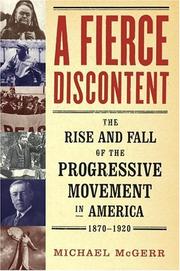
Two books give you the period: Walter T. K. Nugent's Progressivism, a very short introduction that acquires the map in a couple of hours and is unusually honest that historians disagree about what progressivism was, and Michael E. McGerr's A fierce discontent, the best full narrative and the strongest statement of the case that progressivism was a radical middle-class project to remake other Americans — coercion included.
Then stop reading historians for a while. Between roughly 1890 and 1920 Americans built most of the machinery they still argue about: food and drug regulation, antitrust enforcement, the income tax, direct election of senators, the Federal Reserve, women's suffrage. The same reform impulse also produced Prohibition, immigration restriction and the country's most influential eugenics movement. Whether that second list is a betrayal of progressivism or an expression of it is the open question, and it is much easier to hold a view about once you have read the primary sources yourself.
The muckrakers, in their own words
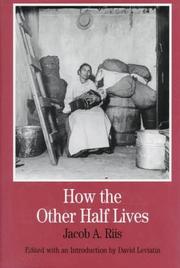
Jacob A. Riis's How the other half lives made urban poverty visible to people who had never seen it, and it should be read critically: Riis's sympathy for the poor sits beside flat ethnic stereotyping in the same paragraphs. Lincoln Steffens's The shame of the cities is his magazine series on municipal corruption and the origin of the whole genre, and it is the clearest statement of the argument that the businessman paying the bribe, not the boss taking it, was the real problem.
A note on The history of the Standard Oil Company. Ida Tarbell's investigation ran as nineteen documented instalments and is a much larger work than the 227-page edition our catalogue holds — what we can supply is a selection, not the whole. It is still the most rigorous investigative journalism of the era; concentrate on the opening chapters and on the South Improvement Company. Upton Sinclair's The Jungle closes the stage: a novel written as socialist argument that produced food regulation instead, its author complaining that he had aimed at the public's heart and hit its stomach. Our record for it carries a nonsense publication year; the book is 1906.
The reformers, and the state they built
Jane Addams's Twenty Years At Hull-House is a participant's memoir by the person with the most invested in how the settlement house is remembered, and it shows the same conditions from inside rather than from a reporter's notebook. David von Drehle's Triangle is the best single case study of how reform actually got made — the Triangle Shirtwaist fire, the strike that preceded it, and the New York factory legislation that followed — and it keeps immigrant women workers at the centre rather than the reformers who spoke for them.
Doris Kearns Goodwin's The Bully Pulpit connects the muckrakers to national politics through Roosevelt, Taft and their collapsing friendship; it is long, and it is popular history in the good sense. Read Nell Irvin Painter's Standing at Armageddon immediately afterwards. It covers the same years from labour and from below, and it is not merely supplying colour Goodwin omitted — it disputes what the period was about, keeping strikes, lynchings and radicals on pages the presidential narrative gives to cabinet meetings.
The argument about what it was
Four books, four theses, and no settled answer. Richard Hofstadter's The age of reform set the terms in 1955: progressivism as the status anxiety of a displaced Protestant middle class. Robert H. Wiebe's The search for order, 1877-1920 is the major rival, reading it instead as a new urban professional class imposing bureaucratic order on a society of island communities. Jackson Lears's Rebirth of a Nation treats the period as a crusade for regeneration — martial, racial, spiritual — and connects the reform impulse to the imperial one, which neither of the first two does. Thomas C. Leonard's Illiberal Reformers is the shortest and hardest: an argument about the economics profession, holding that the progressive economists who built the regulatory state were in large numbers eugenicists whose minimum-wage and immigration policies were designed partly to exclude people they judged unfit. It assumes you can follow a technical case about labour-market exclusion. Read it last, and read it as a strong thesis under test rather than as a verdict.
The full ordered path, with study plans, is at /paths/pt_ai_the-progressive-era.
Ready to learn something deeply?
Build a reading path — free