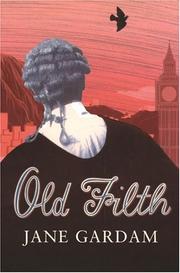
Start with Old Filth, and read the three in publication order: Old Filth, then The Man in the Wooden Hat, then Last friends. This is one marriage told three times. The first book is Edward Feathers's life, the second is his wife Betty's account of the same decades, the third belongs to Terry Veneering, the rival who shadowed them both.
Order matters here more than in almost any trilogy, because each book withholds precisely what the next one supplies. Betty's novel opens with a decision that reframes fifty years of what Edward believed about his own marriage. Learn it first and you spend book one watching a man be wrong instead of believing him — which is the entire experience the trilogy is built to give you and then take away.
The trilogy, in order
Old Filth — the nickname stands for Failed In London Try Hong Kong — is a retired judge in Dorset remembering a childhood as a Raj orphan sent home to strangers in Wales. It runs about 289 pages and is complete in itself, which is why many readers stop there; it is also, you discover later, an unreliable account. The Man in the Wooden Hat is roughly 261 pages and must be read second. Last friends, about 236 pages, is the least self-sufficient of the three and the one that makes the design visible. The three come to under eight hundred pages between them, and they reward being read close together.
The world just outside the trilogy
The people on Privilege Hill and other stories is a story collection whose title piece returns to Old Filth in retirement among the same neighbours — effectively a coda, and the only other place these characters appear. Read it after the first novel.
Children of the Raj by Vyvyen Brendon is not fiction: it is a 376-page social history of the British children shipped back from India to boarding schools and paid guardians, often not seeing their parents for years. It is the exact system that produced Edward Feathers. Read it after the three novels and he stops being an eccentric and becomes a type.
Gardam's early novels
Gardam wrote for fifty years before the trilogy and was in her seventies when she began it. A long way from Verona is her first novel, narrated by a thirteen-year-old in a wartime seaside town who has been told she is a genius and believes it — the freshest voice she ever wrote. Bilgewater puts a headmaster's awkward daughter in a boys' boarding school in a comic novel that keeps turning serious without announcing it. God on the rocks, Booker-shortlisted in 1978, watches an eight-year-old in a strict evangelical household register facts whose meaning will not arrive for decades — which is the trilogy's technique, thirty years early.
The mid-career novels
Crusoe's daughter covers eighty years of a woman's life in a yellow house on a salt marsh, held together by an obsession with Robinson Crusoe; Gardam named it her own favourite, and it is the obvious rehearsal for the long retrospective life of Old Filth. The queen of the tambourine is an epistolary novel of letters to a neighbour who may not be receiving them, and it won the Whitbread — note that our catalogue record carries a 1960 date, which is wrong by three decades and should be read as noise in the metadata rather than a fact about the book. Faith Fox is her most socially panoramic novel, and The flight of the maidens — three Yorkshire girls in the summer of 1946 — is the last book before the trilogy and the closest to it in method.
The short stories
Black Faces, White Faces is linked stories of English visitors in Jamaica and won both the David Higham and Winifred Holtby prizes. The Pangs of Love includes the Whitbread-winning title story, a sequel to The Little Mermaid told by her younger sister. Read them together and the trilogy stops looking like a late departure: retelling a known story from the position that was left out is what Gardam always did.
The full ordered sequence is on the Old Filth reading path.
Ready to learn something deeply?
Build a reading path — free