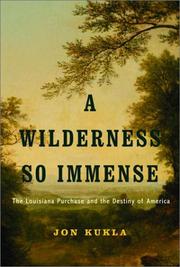
Start with Jon Kukla's A wilderness so immense, the best single-volume account of how the United States came to buy roughly 828,000 square miles from France in 1803. It treats the Mississippi navigation crisis — the closure of the New Orleans deposit, on which the whole western American economy depended — as the thing that actually drove policy, and it covers a longer run-up than the shorter narratives, so nothing has to be re-established later.
The reason this subject rewards an order is that the bargain-of-the-century framing is the least interesting true thing about it. The purchase happened because the Haitian Revolution destroyed Napoleon's army in the Caribbean; it required a strict-constructionist president to do something he himself said the Constitution did not authorise; and it transferred tens of thousands of people who were never consulted. Read those pieces in the wrong sequence and the whole thing looks like luck. This list builds them in order: the transaction, then Haiti, then the constitutional problem, then the consequences.
The transaction, and why Napoleon sold
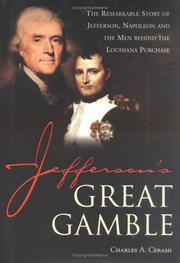
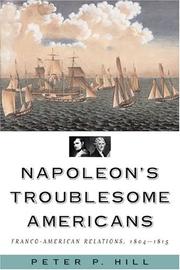
After Kukla, Charles A. Cerami's Jefferson's great gamble is the close-up — a faster narrative of the negotiation itself, strong on Livingston in Paris and on Talleyrand. Peter P. Hill's Napoleon's Troublesome Americans covers the Franco-American relationship in the years immediately before the sale, including the undeclared naval Quasi-War, and explains the strange footing the two governments were on by 1803, which both narratives above largely assume.
Then the part most American accounts omit. Laurent Dubois's Avengers of the New World is the best modern history of the Haitian Revolution, and its chapters on the Leclerc expedition are the hinge: Louisiana was conceived as the granary for a restored Caribbean sugar empire, and once Saint-Domingue was lost the granary was worthless. C. L. R. James's The Black Jacobins comes second, deliberately. It is a committed Marxist and Pan-Africanist argument about revolution rather than a survey, and it still shapes how the subject is discussed. One catalogue note: our record dates it to 1935, which is wrong — the work is the 1938 classic.
The constitutional problem
Peter J. Kastor's The Louisiana Purchase is a documentary collection, assembling the treaty, the congressional debate, the diplomatic correspondence and the contemporary press. It is the fastest route to the arguments themselves rather than to summaries of them, and it should not be confused with Kastor's own monograph, which appears later on the list. Peter S. Onuf's Jefferson's empire is the hardest reading here despite being among the shortest — intellectual history working out what Jefferson meant by an empire of liberty, and how expansion and republicanism were meant to reinforce rather than contradict each other. Sanford Levinson's essay collection The Louisiana Purchase and American Expansion, 1803-1898 reads 1803 forward and asks whether the constitutional questions it raised about governing acquired peoples were ever answered; note where its date range ends.
What the purchase did
Kastor's The nation's crucible is the monograph, and the most important book here on human consequence: how Louisiana's Creole, French, Spanish, African and Native inhabitants were made, or not made, into Americans. Roger G. Kennedy's Mr. Jefferson's lost cause is the sharpest counterweight to the bargain framing, arguing that the purchase delivered a vast territory to cotton and to slavery and destroyed the yeoman republic it was supposed to secure. Stephen E. Ambrose's Undaunted Courage on Lewis and Clark is popular narrative rather than scholarship, included because the expedition is inseparable from the purchase in American memory; Ambrose's scholarly reputation was later damaged by findings of unattributed borrowing in other books, which is worth knowing. Bernard Augustine De Voto's The course of empire is the long, slow corrective, placing Lewis and Clark inside two centuries of European movement across the continent, in prose whose assumptions about Native peoples belong to its period. Gordon S. Wood's Empire of liberty, the Oxford History volume on the early republic, goes last, once you know which of its passing judgements you want to argue with.
One gap worth naming
Dumas Malone's multi-volume Jefferson biography is not on this list. The volume covering the Purchase would not resolve in our catalogue — the probe returned his volume on Jefferson's second term instead — so rather than list the wrong book we left him out. If you want Jefferson at full biographical length on these years, that is where to go outside this path. We also hold no page count for Empire of liberty, so plan it as a commitment rather than around a figure we cannot supply.
The full ordered sequence, with a study plan for each stage, is at /paths/pt_ai_the-louisiana-purchase.