Iran-Contra is two covert operations that had no business meeting. One sold missiles to Iran to free American hostages in Lebanon, in defiance of an announced policy of never negotiating with hostage-takers. The other kept the Nicaraguan contras armed after Congress had cut off funding by law. They were joined when profits from the first were routed to the second, and that diversion is the thing people remember — which is unfortunate, because it is the least important part.
The reading order therefore matters more than usual. Take a narrative first so you can hold both operations in mind at once, then the committee and prosecutorial record, then the participants defending themselves, and only then the interpretive argument about how far up it went. Come at it through the memoirs first and you will end up arguing about a single man's shredder.
The narrative
Landslide covers Reagan's second term and treats Iran-Contra as the thing that happened to a presidency already drifting, with a disengaged president and an unusually powerful staff. Jane Mayer and Doyle McManus reported it while the story was live, and it remains the most readable way in.
Men of zeal is written by two senators who sat on the joint investigating committee, which makes it the rarest sort of book on this path: the investigators explaining what the hearings could and could not establish, and why the immunity grants to Oliver North later wrecked the prosecutions.
The two serious histories, and their disagreement
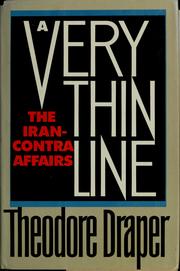
A very thin line is Theodore Draper's forensic reconstruction, built almost entirely from the documentary record produced by the investigations. It is exhaustive, cold, and deliberately restrained about the central question. Draper traces the operations in detail and stops short of asserting that Reagan directed or approved the diversion, on the grounds that the evidence available to him did not establish it.
Iran-Contra by Malcolm Byrne is the later account, written after two more decades of declassification, and it argues the opposite conclusion: that the arms sales and the contra resupply effort were presidential policy, known to and driven by Reagan, and that the "rogue operation" framing was a defence rather than a finding.
These two are a genuine dispute, and it is not simply a matter of one writer being right. They worked from different evidence at different distances, and they set different bars for what counts as established. Read Draper for the discipline and Byrne for the documents Draper never saw, and notice that they agree on nearly all the facts and disagree about attribution.
The Iran-Contra scandal is Peter Kornbluh's documents reader, assembled from the National Security Archive's declassified holdings. It is the primary source shelf for the whole subject and the place to check either historian's claims yourself.
The participants
Under Fire is Oliver North's own account and should be read as advocacy, which is its value: it is the fullest statement of the case that the operations were authorised, patriotic and criminalised after the fact.
Firewall is the answer from the other side — Lawrence E. Walsh, the independent counsel, on a six-year investigation that convicted people and then watched immunity deals and a presidential pardon undo the results. It is a bitter book by a lifelong Republican, and unusually candid about prosecutorial failure.
Veil is Bob Woodward on the CIA under William Casey, whose role in Iran-Contra was cut short by illness and death. Its famous deathbed scene is disputed and you should treat it that way, but the surrounding account of Casey's covert-action programme is essential context.
The Reagan diaries are worth an afternoon's reading against the histories, because what the president recorded privately about the arms sales is itself evidence in the dispute above.
The wider frame
Bitter fruit goes back to the 1954 overthrow of Guatemala's government and establishes the American covert-action habit in Central America that Nicaragua sat inside. Comandos is Sam Dillon on the contras themselves, from the inside — the least Washington-centric book here and a corrective to treating them as an abstraction. Guts and glory is Ben Bradlee Jr.'s biography of North, written before the memoir and much less flattering. The Age of Reagan closes the path by putting the scandal inside Sean Wilentz's larger and openly argued account of the era.
For adjacent political histories, start from Discover.
Follow the full ordered path here: Best Books on the Iran-Contra Affair, in Reading Order.