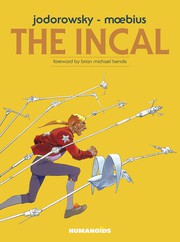
Start with The Incal, the Jodorowsky and Moebius collaboration, 309 pages in our record. Every other question about this universe is downstream of that one, and the honest recommendation is that a large number of readers should stop there. The Incal is complete in itself: John Difool, a low-grade private investigator in a vertical city, ends up carrying an object that everything in the cosmos wants, and Moebius draws it at the height of his powers.
The obvious alternative starting point is Before the Incal, because the title says it comes first. It does not work that way. As an opening book it is a grubby noir about a character you have no reason to care about; as a second book it explains a great deal.
Content, stated plainly: Jodorowsky's comics contain explicit sexual material and extreme violence throughout, and many readers find both gratuitous. That is true of the whole path and not just the outliers.
The Jodoverse proper
Before the Incal (304 pages) is Difool's backstory, drawn by Zoran Janjetov in a deliberate Moebius pastiche. Final Incal is Jodorowsky's late reworking of the ending with Ladrönn, at 215 pages; treat it as an alternative rather than a conclusion, because it partly overwrites what you have already read.
The Metabarons is the best of the spin-offs by a wide margin — the dynastic history of the Metabaron glimpsed in The Incal, drawn by Juan Giménez. One catalogue note: we hold a single record for it, stored as The Metabarons : Volume 1 at 136 pages, and searches for the omnibus return that same record. Start there rather than hunting for a collected edition on our pages.
The Technopriests — our record files it inverted, as Technopriests, The — is the other major branch, following Albino through the Techno-Techno order. Most readers rate it below the Metabarons, but it gives the fullest picture of the setting's religion and industry.
The outer edges
Megalex is a separate but tonally identical dystopia drawn by Fred Beltran, and the clearest demonstration that Jodorowsky has a template he returns to. Read it once you can recognise the pattern, so the repetition reads as interesting rather than tiring. Eyes of the Cat is the first Jodorowsky and Moebius collaboration, from 1978 — 56 pages, almost wordless, and extremely nasty. It belongs here as the origin of the partnership rather than as an entry point.
Moebius on his own
Worth separating the artist from the writer. Arzach is wordless and plotless and is probably the single most influential piece of European science-fiction comics; our record for it is a French edition, so check the listing before ordering. The airtight garage was improvised chapter by chapter with no plan and is the closest Moebius came to writing a Jodorowsky story himself — the best available evidence of what each man brought to the collaboration. The World of Edena is his late long-form work, 350 pages collected in one volume, calmer and stranger than The Incal.
Jodorowsky outside the Jodoverse
The White Lama, with Georges Bess, is the most straightforwardly beautiful thing he has written: Tibetan reincarnation played without irony. The Madwoman of the Sacred Heart reunites him with Moebius in contemporary Paris rather than deep space and is much funnier than his reputation suggests. Bouncer, his western with François Boucq, has the most disciplined plotting in his comics work, which is the clearest proof that the excess elsewhere is a choice. Son of the gun is the most extreme book on this path by some distance — a Mexican crime saga with no restraint at all. It is placed last, and last is where it should stay.
Where to stop
After The Incal, if you want one book. After The Metabarons : Volume 1, if you want the best of the universe and none of the churn. The full ordering, with what each volume adds, is at the Incal reading path.