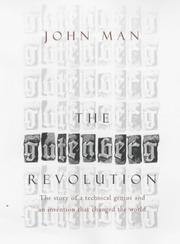
Begin with John Man's The Gutenberg revolution, a popular narrative of the workshop itself — the punches and matrices, the loans, the lawsuit that cost Gutenberg his own press. One warning before you buy: the same book was published in the United States as Gutenberg: How One Man Remade the World with Words, and the two titles are catalogued as separate records. Buy one.
The reason this subject needs an order is that the interesting part is not the machine, it is the causal claim. Almost everyone knows that printing changed Europe. Almost nobody can say what the change is supposed to have been, and historians have been arguing about it for forty years. Read the argument before you have the commercial facts and you will find both sides convincing, which is the usual outcome.
Gutenberg and the machine
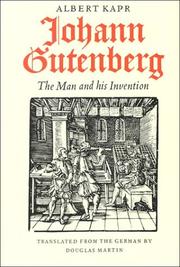
Johann Gutenberg is the serious biography, by the German typographer and historian Albert Kapr, and it is far better than Man on the metalwork and on the documentary evidence — which is thin enough that much of the standard story is inference. Read it second, as the correction to the popular version.
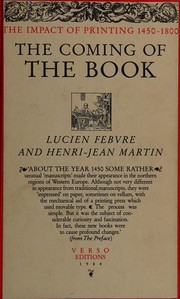
The Coming of the Book is where the social history of printing begins. Lucien Febvre and Henri-Jean Martin's 1958 study is still the best single account of print as an industry: paper supply, capital, distribution, what the trade printed and for whom. Everything after it is either building on this book or arguing with it.
What the early trade was actually like
The book in the Renaissance is the best modern account of the first century and a half of European printing, and it is a deliberate corrective. Andrew Pettegree shows a fragile, frequently bankrupt trade whose profits came from indulgences, pamphlets and schoolbooks rather than from the great folios we remember. Read it before you assess anyone's thesis about print's effects.
Brand Luther is the same argument in miniature, and the concrete answer to the vague claim about print and the Reformation: Luther wrote short, printed cheap, worked closely with a Wittenberg printer on typography and title pages, and effectively invented a publishing format.
The argument the subject turns on
The printing revolution in early modern Europe is Elizabeth Eisenstein's own one-volume abridgement of her case — that print brought fixity, standardisation and wide dissemination, and that these were preconditions for the Reformation, the Renaissance and the scientific revolution. Read this rather than her two-volume The Printing Press as an Agent of Change unless you need the full apparatus; the argument is the same and the longer version is catalogued separately.
Then read The nature of the book directly afterwards. Adrian Johns argues that print in early modern England was anything but fixed — piracy, misattribution and unreliable texts were normal — so the credibility Eisenstein credits to the technology had to be manufactured socially instead. It is 765 pages and a formidable book in its own right. Taken alone, either book is convincing, which is the point of reading them consecutively. Divine Art, Infernal Machine is Eisenstein's late study of how printing has been talked about since the fifteenth century, simultaneously as divine gift and engine of sedition; it is also where she answers her critics.
News, censorship and the underground
The invention of news follows print into the business it created between roughly 1400 and 1800 — manuscript newsletters, broadsheets, the first newspapers, and the persistent problem of whether any of it was true. It is the natural sequel to Johns on credibility, applied to information rather than books.
The business of enlightenment is Robert Darnton reconstructing the publishing history of the Encyclopedie from a printer's surviving archive: the financing, the smuggling, the padded print runs, the buyers. Nothing else in the field shows so clearly what an intellectual monument looks like from the accounts ledger. The Literary Underground of the Old Regime is shorter and sharper — the hack writers, libels and pornography that Darnton argues did more to corrode royal authority than the philosophes did.
Where the field has moved
The order of books is Roger Chartier at 126 pages of dense essays on catalogues, libraries and the idea of the author, shifting attention from producers to the systems that organised what they produced. Finish with The Book, Keith Houston's unashamedly enjoyable technical history of the physical object — papyrus, parchment, paper, ink, type, binding. After four stages of argument about what print meant, it is worth being reminded in detail what a book actually is. You can follow the whole sequence with its stage goals at /paths/pt_ai_the-history-of-the-printing-press.