Switzerland is the European country hardest to explain by the usual rules: no common language, no founding nation, no monarch, no empire, and a habit of not fighting the wars going on around it. The reading order that works builds the country up in the sequence that explains it — confederation and religious split, then the machinery of federalism, direct democracy and the citizen army, and only then the argument the country still has with itself about 1939 to 1945.
That last point is the practical one. Do not start with the wartime books. They are the most interesting stage on this list and the least intelligible cold, because every position in that fight assumes you already know what a militia army, a cantonal veto and a popular initiative are.
The country in one volume
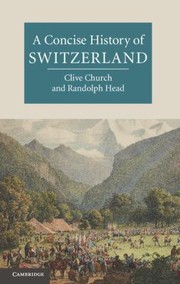
A Concise History Of Switzerland, by Clive Church and Randolph Head, is the current standard survey in English, from the medieval cantons through the Napoleonic interlude and the brief Sonderbund civil war of 1847 to the present. Almost everything else here assumes its chronology. Follow it with Jonathan Steinberg's Why Switzerland?, an older book and a better one on the puzzle rather than the timeline — language, federalism, neutrality and money worked through as an essay-length answer to the question in its title.
The Reformation and the split that nearly ended it
The deepest Swiss fault line was confessional long before it was linguistic. Zurich under Zwingli and Geneva under Calvin made the Confederation a headquarters of the Reformation while the forest cantons stayed Catholic, and that division ran directly into 1847 and the federal constitution of 1848. W. P. Stephens's Zwingli is a short, clear introduction to the reformer whose city-state model of a reformed polity is the ancestor of a good deal of Swiss political culture, and he is the less written-about of the two. Bruce Gordon's Calvin is unusually good on Geneva's politics rather than only its doctrine. Read both for the politics; and note that Geneva did not actually join the Confederation until 1815.
How it actually works
In Switzerland the machinery is the history. Wolf Linder's Swiss Democracy is the standard scholarly account of consensus government, federalism and direct democracy, written by a Swiss political scientist and explicitly framed as a possible model for other multilingual societies. Clive Church's The politics and government of Switzerland is the descriptive half to Linder's analytical one — the institutions in operation.
Then read John McPhee, who attached himself to a Swiss army unit and came back with the best short explanation of the militia system, the demolition charges built into the country's own bridges, and what national defence looks like when every man is a soldier. Our catalogue truncates the title mid-word as La Place de La Concorde Su; the published book is La Place de la Concorde Suisse, from 1984, and it is about 150 pages. Come out of this stage able to explain why direct democracy is both the proudest Swiss institution and the reason women in one half-canton could not vote in local elections until 1990.
Neutrality, the war and the gold
This is a live fight, and the path does not settle it. Stephen Halbrook's Target Switzerland is the strongest statement of the deterrence case: universal military service, the Alpine redoubt, and German invasion plans drawn up and never executed. Halbrook is an American gun-rights lawyer as well as a historian and the argument carries a purpose beyond Swiss history; read it knowing that.
Against him, Tom Bower's Nazi gold is the investigative account that broke the dormant-accounts scandal open in 1997, tracing looted gold through the Swiss National Bank and the commercial banks' handling of Holocaust survivors' claims. Jean Ziegler's The Swiss, the Gold, and the Dead makes the prosecution case from inside — Ziegler was a Swiss MP and the book was received at home as something close to treason. It is polemical and has been challenged on specifics, and it is indispensable for understanding the domestic fight.
Switzerland and the Second World War, a scholarly collection edited by Georg Kreis, who chaired Switzerland's own commission of inquiry, is the measured counterweight to both, covering refugee policy, economic collaboration and postwar memory. Much is not actually in dispute: Switzerland traded with the Reich, its banks handled looted gold, and refugee policy turned Jews back at the border. What is argued over is what neutrality bought, what it cost other people, and whether an invasion was deterred or simply never worth Germany's trouble. Read all four and notice which questions each one declines to ask.
The modern country
Swiss Made is the best available answer to why Swiss prosperity is not only a banking story, taken sector by sector. Diccon Bewes's Swiss watching is an English resident's sharp tour of the society, useful exactly where the scholarly books go quiet. Stephen O'Shea's The Alps puts back the geography every institution in this path was built around.
The full sequence, with study plans, is the history of Switzerland reading path.