Start with Keith Hitchins and then read Lucian Boia against him. That pairing is the method for Romanian history: Hitchins wrote the field's standard account in English, and Boia is the country's leading demythologising historian, whose subject is how Romanian history was written to serve national claims — Dacian continuity, Latin identity, the eternal borderland. Take the narrative first and the demolition second, because Boia's corrections only land if you know what is being corrected.
The second thing worth knowing before you start is that two live political fights sit inside this history — over the Antonescu regime's part in the Holocaust, and over what December 1989 actually was — so the order below reaches each of them with the scholarship already in place.
Romania in one volume
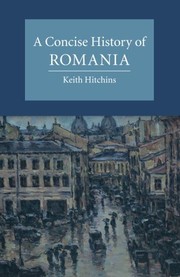
A Concise History of Romania (Cambridge Concise Histories) is Hitchins's single-volume narrative, running from the Roman province to the post-communist decades in a little over 320 pages. It is the efficient way to acquire the chronology. Boia's Romania, filed in our catalogue under the bare title, is short, sceptical and the necessary counterweight to any straight national narrative.
The principalities, unification and Greater Romania
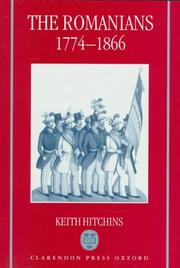
Hitchins's two large volumes are the backbone of the path. The Romanians, 1774-1866 covers Ottoman suzerainty, the national awakening, the 1848 generation and the union of Wallachia and Moldavia. The sequel takes the story through independence in 1878, the kingdom, the First World War and the interwar collapse — and a catalogue note matters here, because it is filed under the older English spelling as Rumania, 1866-1947. Searching with the modern spelling returns nothing. At 579 pages it is the longest book on the path.
Then Boia's central work, History and Myth in Romanian Consciousness, which takes the founding myths apart one at a time. It belongs after the Hitchins volumes, not before them.
The Iron Guard, Antonescu and the Holocaust in Romania
This is the most contested ground in the subject, and the contest is over interpretation rather than over whether the killing happened. Roland Clark's Holy legionary youth is the best modern study of the Legion of the Archangel Michael as a lived movement — recruitment, ritual, violence — rather than as an ideological curiosity. Dennis Deletant's Hitler's forgotten ally is the central scholarly text on Ion Antonescu, and weighs the German alliance, the killings, and Romania's 1942 decision to halt deportations from the Old Kingdom without letting any of the three excuse the others.
The Holocaust in Romania by Radu Ioanid is the documentary reconstruction, largely from Romanian archives, of the destruction of Jews and Roma under Antonescu. Elie Wiesel appears on the catalogue record because he wrote the foreword; the book is Ioanid's. The deportations to Transnistria, the Iasi pogrom and the killings in Bessarabia and Bukovina are documented fact, with estimates for the number of Jews killed by the Romanian state and its forces running from roughly 280,000 to 380,000. Romania denied this officially for six decades until its own commission, chaired by Wiesel, reported in 2004, and Antonescu is still publicly rehabilitated by some. Close the stage with Mihail Sebastian's Journal, 1935-1944, a Jewish writer in Bucharest recording the decade in which his friends became fascists.
The Securitate state
Deletant's Romania under Communism is the authoritative survey from 1945 to 1989, drawing on Securitate archives he was among the first Western historians to work in. Ion Mihai Pacepa's Red Horizons is a defector's account of Ceausescu's inner circle: sensational, self-serving, substantially corroborated later, and best treated as a source to be checked rather than trusted. Herta Müller's novel The Land of Green Plums supplies what the archives cannot — what constant informing does to friendship. Between them you get the texture of the specific Romanian version: the informer density, the systematisation of villages, Decree 770 banning contraception and abortion, and the debt repayment that starved the country in the 1980s.
1989 and after
Edward Behr's Kiss the hand you cannot bite is the best narrative of December 1989, written immediately afterwards and honest that the truth was not yet established. Whether the revolution was a genuine uprising, a palace coup that captured one, or both at once, is still argued in Romania. William Blacker's Along the enchanted way then closes the path in the villages of Maramures, where an older Romania survived the whole century — the ground all the political history was happening on top of.
The stages, each with a study plan, are on the history of Romania reading path.