Most history-of-physics reading lists fail in one of two ways: they are popular science with dates attached, or they open with a book that assumes you have met Lagrangians. This order solves that by escalating deliberately. The first two stages need no mathematics at all; the Pais and Pickering volumes near the end assume you have met quantum mechanics and are comfortable with equations on the page. The escalation is stated at each step, so you can stop where the mathematics outruns you without losing the story.
Start with Faraday, Maxwell, and the electromagnetic field. Nancy Forbes and Basil Mahon's paired biography sets two utterly different scientific temperaments against each other and gives the clearest popular account of how Faraday's lines of force became Maxwell's equations — the moment a field replaced action at a distance, which everything later rests on.
The field, and the men who built it
The Maxwellians is the scholarly sequel and a corrective to the great-man version. Bruce Hunt shows that Heaviside, FitzGerald, Lodge and Hertz did most of the work of turning Maxwell's sprawling treatise into the four equations we now recite. It is short, and it is the best demonstration on this path that theories are finished by communities rather than by individuals.
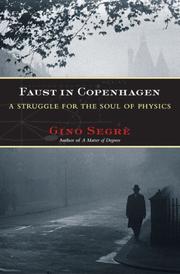
Faust in Copenhagen is the bridge from classical to quantum: the 1932 Bohr institute meeting as a portrait of the generation that made quantum mechanics, with Bohr, Dirac, Heisenberg, Pauli, Meitner and Ehrenfest in the room. Still no mathematics required.
A warning that catches people out. There are two different physicists named Segre on this path, and they are not the same man. Gino Segre, a theoretical physicist, wrote Faust in Copenhagen; his uncle Emilio Segre, the Nobel laureate who co-discovered the antiproton, wrote From x-rays to quarks in the third stage. Different books, different arguments, easily conflated in a catalogue search.
The quantum revolution as it happened
Thirty years that shook physics is George Gamow's participant account, written in 1966 and illustrated with his own cartoons. Slight and idiosyncratic, and included first because reading someone from inside the period makes the later historians' framings visible as framings. Then Quantum, Manjit Kumar's narrative of the Einstein-Bohr argument carried through to Bell's theorem; it takes the interpretation question seriously as physics rather than as philosophy, which most popular accounts do not.
The making of the atomic bomb closes the stage at 886 pages. Richard Rhodes's book is placed here not as a war book but as the finest history in English of the physics of 1900 to 1945 — the fission discovery, the emigrations, and the moment the discipline stopped being an academic one.
The scholarly survey
Quantum Generations is the pivot of the whole path. Helge Kragh's survey of twentieth-century physics covers everything the narratives leave out — condensed matter, geophysics, instrumentation, the institutions and the funding — and treats physics as a social institution as well as a set of ideas. It is written to be read straight through, which is unusual for a book of its scope, and it is the single most useful item here.
From x-rays to quarks is Emilio Segre's history of modern physics, written by someone who knew most of the people in it. His judgements about what mattered are those of a working experimentalist, which is a useful contrast with Kragh's historian's distance. This is where the path first assumes some undergraduate physics.
Scientific biography done properly
Subtle Is the Lord is the definitive scientific biography of Einstein, by a physicist who worked alongside him at Princeton. Abraham Pais reconstructs the actual papers, so this is the book that shows you what Einstein did rather than what he was like — and it contains real derivations. Niels Bohr's times is Pais's companion volume and the necessary counterweight, because Bohr's influence ran through conversation and institution-building as much as through publication. Then Genius, James Gleick on Feynman: the best-written book on the path, and a deliberate contrast — a journalist's biography that succeeds through prose and structure where Pais succeeds through physics.
Particle physics, and the historian's critique
The second creation is the readable entry to the accelerator era, built by Robert Crease and Charles Mann out of interviews with almost everyone still living when they wrote. Inward bound is Pais again and the most technically serious history of matter and forces in the century — experiment by experiment, with the mathematics kept in — best used as the reference against which the narratives can be checked.
End with Constructing quarks. Andrew Pickering argues that high-energy physics chose its facts as much as it found them, a position most physicists reject and most historians of science take seriously. It is last because you need the previous four stages to argue with him properly. Whether you finish agreeing is not the point.
Fourteen books, about 6,570 pages, with the technical demand rising throughout. The stage-by-stage order is on the history of physics path.