The history of photography has been written twice: once as a lineage of inventors and masterpieces, and once as an argument that the first version was largely a museum's invention. Read the theory before the surveys and you will be arguing about a canon you cannot picture. Read the surveys first and the critique lands.
So: acquire the images, then the canon, then the arguments about it. The genius of photography is the most readable way in — Gerry Badger's companion to the BBC series, 256 pages, thematic rather than strictly chronological, and generous with reproductions.
The narrative surveys
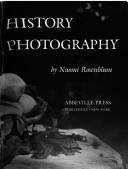
A world history of photography is the standard comprehensive survey and genuinely international where the older histories were Anglo-American. At 704 pages Naomi Rosenblum's book is a reference as much as a read; its technical sections between chapters are the clearest short account anywhere of how the processes actually worked, which is what lets you place a picture by its look. Then Mary Warner Marien's survey, catalogued simply as Photography, which reorganises the same material around use rather than authorship and treats the medium as embedded in social history.
A note on our records: two different books on this path display as Photography. The 556-page one is Marien's textbook; the 420-page one, further down, is Liz Wells's theory reader. Go by author and page count when you are ordering.
The canon, and who made it
The history of photography from 1839 to the present day grew out of a 1937 exhibition at the Museum of Modern Art and effectively created the field's canon. Read Beaumont Newhall now as a primary source: the standard history and, simultaneously, the thing every later critic is reacting against. The photographer's eye is John Szarkowski, who ran photography at MoMA after Newhall, making the formalist case in about forty pages — the thing itself, the detail, the frame, time, vantage point. Short, enormously influential, and the clearest statement of the position the next two stages attack.
The arguments everyone still has
On Photography is six essays from the 1970s and still the most cited writing on the medium: photography as acquisition, as aggression, as an anaesthetic for the conscience. Expect to disagree with Susan Sontag and to be unable to get around her. Camera Lucida is Roland Barthes's last book, written after his mother's death, and the source of the studium and punctum distinction the whole field now uses — half theory, half grief, and the strongest available argument that a photograph's power is indexical rather than pictorial. Ways of Seeing is not only about photography; it is here because John Berger's account of how reproduction changes an image, and how advertising borrows the language of oil painting, is the fastest route into the political reading that follows.
Two of these records are foreign-language editions filed under their English titles. The ISBN we hold for On Photography is registered to a German publisher and the one for Regarding the Pain of Others to a Brazilian publisher, so those two buy links may land on a translation. Check the language before ordering. The Camera Lucida record's ISBN is an English-language one, but the edition is a reissue rather than the familiar paperback, so it is worth a look before you click.
Photography as an instrument
The burden of representation is the hard turn. Working from archives of police and public-health photography, John Tagg argues that the camera's authority is granted by the institutions using it rather than by anything in the image — the most rigorous rejection of the Newhall and Szarkowski position on this path. Regarding the Pain of Others is Sontag revising her own position on war and atrocity photographs twenty-five years later, and much less certain; read it against On Photography, because the change of mind is the lesson. Liz Wells's Photography is the standard university reader on photographic theory — documentary, the body, the archive, the gallery — and the best map of the field's arguments if Tagg is heavy going.
The histories written since
Bystander is Colin Westerbeck and Joel Meyerowitz on street photography from Atget onward, and the best sustained account of a practice defined by a relationship to strangers rather than by a subject. The photobook, a history rewrote the field's terms by arguing that the important unit is the book rather than the print; Martin Parr and Gerry Badger fill it with work no museum history had covered. Finish with The photograph as contemporary art, in which Charlotte Cotton organises three decades of gallery photography into workable categories — the test of which arguments from the middle of this path practice actually took up. It is a stopping point rather than a conclusion, which is the honest shape for this subject.
Fourteen books, about 4,215 pages. The ordered list with stage goals and lengths is on the history of photography path.