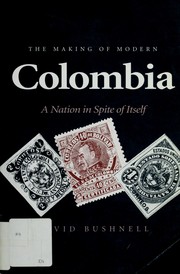
Read the institutional history first. Michael J. LaRosa and Pamela Murray's Colombia : a concise contemporary history is the shortest reliable overview and is deliberately resistant to the drugs-and-violence framing that dominates foreign writing about the country; David Bushnell's The making of modern Colombia, subtitled A Nation in Spite of Itself, is the standard English-language history from independence to about 1990 and the book the rest of the field assumes you have read.
Do that before anything on La Violencia or the FARC, because the paradox every serious book about Colombia tries to explain is that a country holding elections almost continuously since the nineteenth century has also been at war with itself for most of that time. Come at the war first and it reads as a national temperament. Come at it after the party system and the geography and it reads as politics by other means, which is what the best historians here argue it is.
The long view
The third book in this stage is Frank Safford and Marco Palacios on how regional fragmentation shaped everything, and it is the clearest treatment anywhere of geography as a political fact. Our catalogue stores it under the bare display title Colombia, with the subtitle lost, and it also stores LaRosa's book with a stray space before its colon — so buy both by author rather than by title. Palacios is easy to lose track of on this path: he co-wrote the Safford volume, wrote the next book on the list, and co-edited the last one.
La Violencia and the National Front
Between legitimacy and violence is Marco Palacios's own interpretation of the whole modern period and the intellectual centre of this path: the state as permanently semi-legitimate, and violence as a form of politics rather than its breakdown.
Forrest Hylton's Evil Hour in Colombia is a short, hard-edged history from the left, strongest on La Violencia and on the continuity between mid-century partisan killing and the paramilitarism of the 1990s. It is argumentative and meant to be argued with. Read Robert A. Karl's Forgotten Peace directly after it, because it is the most important recent revision: Karl recovers the genuine peacemaking of the late 1950s and early 1960s and argues that the standard account has read the failure of that moment backwards into inevitability. Those two books disagree about what was possible, and the disagreement is the point of reading them together.
The war at ground level
Robin Kirk's More Terrible Than Death is a human rights researcher's account of the drug war and the dirty war as one thing, built on years of fieldwork with victims on every side, and it is the humane book to read before the analytical ones.
Walking Ghosts is Steven Dudley on the destruction of the Union Patriotica, the FARC's attempt at a legal political party, some three thousand of whose members were murdered. It is essential background to why disarmament was so hard to sell decades later. Garry M. Leech's The FARC is a short, sympathetic-but-not-uncritical history of the guerrilla organisation from something closer to the inside; read it knowing the author's politics are on the page. Michael Taussig's Law in a lawless land is a diary of two weeks in a Cauca town during a paramilitary limpieza — anthropology written as testimony, and the closest thing here to what the war felt like from within a small town.
Cocaine, and the peace
Mark Bowden's Killing Pablo is the most readable account of the Medellin cartel era and the hunt for Escobar; it is popular narrative with an American frame, so take the events and treat the politics with caution. Gabriel García Márquez's News of a Kidnapping is reportage rather than fiction, on the Escobar-era kidnappings of prominent Colombians, and it conveys what the cartel war did to Bogota's political class better than any history.
Finish with The Colombia reader, the Duke University Press volume edited by Ann Farnsworth-Alvear, Marco Palacios and Ana Maria Gomez Lopez — 648 pages of documents, testimony, fiction and images across the whole national history, including material from the peace process. It is a book to keep rather than to finish. The full ordered path, with the stage goals and study plans, is at /paths/pt_ai_the-history-of-colombia.