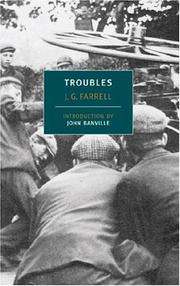
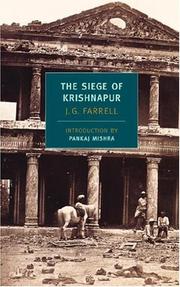
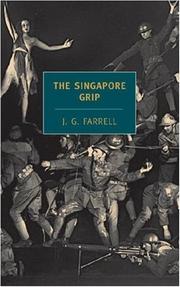
Start with Troubles. The obvious alternative is The siege of Krishnapur — stored in our catalogue under that lower-cased form and published as The Siege of Krishnapur — because it won the Booker and it is the tightest and funniest of the three. It is also the most concentrated version of a joke that lands much harder once you have met the gentler version. Troubles is that gentler version: a demobbed major arrives at a vast, rotting hotel on the Irish coast in 1919 to marry a woman he barely remembers proposing to, and the building disintegrates around him while the War of Independence happens somewhere off the page.
Then read The siege of Krishnapur, then The Singapore Grip (Empire Trilogy #3). That is publication order — 1970, 1973, 1978 — and our records put the three at 446, 344 and 572 pages.
This is not a trilogy in the ordinary sense
The three novels share no characters, no continuing plot and no narrator. One is set in Ireland in 1919, one in India in 1857 and one in Singapore in 1941. What carries over is an argument, made three times: the British Empire discovering that it has already ended and continuing to behave as though it has not. Nothing is spoiled by starting elsewhere, and a reader who picks up the second book first will not be lost for a second.
Publication order still earns its place, because the argument sharpens book by book. Troubles is comic and elegiac and leaves the politics almost entirely outside the frame. The siege of Krishnapur makes the same point unbearably concrete — a garrison firing the busts of European poets out of its cannon as the ammunition runs out. The Singapore Grip (Empire Trilogy #3) is the longest, the angriest and the one that names the money: a rubber-trading dynasty carrying on with dinner parties as the Japanese come down the peninsula. It is also the least loved of the three, and the place readers stall.
The unfinished fourth
The hill station is a fragment, not a novel. Farrell drowned in 1979 while fishing off the Irish coast, leaving a Victorian doctor travelling up to Simla into a church controversy; our record runs to 254 pages and lists John Spurling alongside Farrell, because the published book carries an editorial afterword reconstructing where the thing was going. Read it fourth, and read it as evidence rather than as a story.
Farrell before he found his subject
Two early novels sit outside the sequence. The lung (1965) came directly out of the polio Farrell contracted at Oxford — a man in an iron lung, and the first appearance of the confinement-and-slow-decay obsession that runs through everything after. A girl in the head (1967) is a comic novel about a displaced Polish count in a shabby English seaside town, more indebted to 1960s literary fashion than to anything he wrote later. Both are short and both are optional; their real use is as the measure of how large a break Troubles was.
The history each novel keeps off the page
Farrell reports his catastrophes at one remove, through newspaper snippets and distant gunfire, which is why the non-fiction is worth adding. Michael Hopkinson's The Irish War of Independence is the standard scholarly account of 1919 to 1921. The last Mughal gives the 1857 rebellion from Delhi and from the Indian sources — precisely the perspective The siege of Krishnapur denies itself by staying inside the residency, and the most important corrective on this path. Singapore Burning is a narrative history of the largest capitulation in British military history; note that its record credits "Colin Smith undifferentiated", which is a library disambiguation marker sitting in the author field, not part of anyone's name. The rise and fall of the British Empire is the single-volume frame at 704 pages, best read last of these once you know which three moments you are looking for.
The imperial fiction Farrell is answering
Heart of Darkness is the origin point for the modern novel of imperial self-disgust and the shortest thing here at 136 pages. A Passage to India is the great liberal novel of the Raj, and the book The siege of Krishnapur argues with. Burmese Days supplies from five years of first-hand police service the sociology Farrell reconstructed from research. The jewel in the crown opens Paul Scott's Raj Quartet, the earnest, enormous treatment of the last years of British India that Farrell answered with comedy instead. Chronological order works for all four.
The full sequence, with the stage notes and study plans, is at the Empire Trilogy reading path.
Ready to learn something deeply?
Build a reading path — free