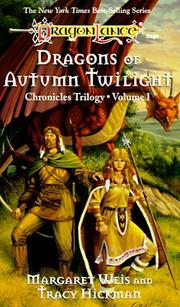
Start with Dragons of Autumn Twilight. Dragonlance is roughly 190 novels by dozens of authors, and that number is why most people never begin. The answer is smaller than the shelf: there is a spine, and it is six books by Margaret Weis and Tracy Hickman. The Chronicles trilogy tells the War of the Lance; the Legends trilogy tells Raistlin Majere's story, and most readers consider it the better half. Read those six and you have read Dragonlance.
The obvious alternative — starting with a chronologically earlier book like Raistlin's childhood, or with the standalone about the ancient knight Huma — is wrong for the same reason it usually is. Those books were written years later for readers who already knew how the characters end.
Chronicles: the War of the Lance
Dragons of Autumn Twilight was published in 1984 and launched the whole setting. It was written out of a tabletop campaign, which is visible in its episodic structure and is part of its charm rather than a defect to apologise for. The friends who reunite in its first chapter carry the next five books. Dragons of Winter Night is where the war turns serious, the party fractures, and Raistlin stops being a sidekick. Dragons of Spring Dawning closes the war. Our catalogue record for that third volume is a mess — it credits an audiobook narrator and a comics adapter alongside Weis and Hickman, and carries an obviously junk year — but it is the 1985 novel.
Legends: the better trilogy
Time of the Twins is Raistlin's bid to become a god, told through a time-travel plot that puts him and his brother Caramon in Istar before the Cataclysm. It requires Chronicles and repays it immediately; this is where the prose gets good. War of the Twins commits fully to Raistlin as a protagonist you follow without being asked to like. Test of the Twins is the ending the setting is remembered for, and the natural stopping point if you read nothing else.
Before the Chronicles
The Soulforge covers Raistlin's childhood and his Test in the Tower of High Sorcery. It was written a decade after Legends, squarely for readers who know how he ends, so read it after Legends and never before. Brothers in Arms is its direct sequel, Raistlin and Caramon as young mercenaries, written by Weis with Don Perrin. The Legend of Huma is the one book outside the Weis and Hickman line a spine reader should not skip: the Knight of Solamnia the Chronicles constantly invoke, by Richard A. Knaak, and a fair sample of what the wider shared world is like at its best.
After the war
The Second Generation is a story collection following the Companions' children and sets up what comes next. Dragons of Summer Flame ends the age and is the most divisive thing Weis and Hickman wrote here — it deliberately breaks Krynn, which is why everything after reads like a different world. Dragons of a Fallen Sun opens the War of Souls trilogy in that changed world and is generally judged their last strong sequence; the two volumes that complete it, Dragons of a Lost Star and Dragons of a Vanished Moon, are not on this path, so continue from there under your own steam. Dragons of the Dwarven Depths (Dragonlance: The Lost Chronicles, Vol. 1) and Dragons of the Hourglass Mage are the first and third Lost Chronicles, written twenty years later to fill gaps the original trilogy skipped; the middle volume, Dragons of the Highlord Skies, is likewise absent here.
What this deliberately leaves out
Nearly everything. The Preludes, Meetings and Heroes sequences, the Elven Nations and Dwarven Nations trilogies, the Raistlin Chronicles beyond the two named above, the Kang's Regiment books, the Age of Mortals novels, the anthologies and the dozens of standalones by other authors — none are here. That is a curation choice, not a claim that they are bad. The full ordered path is a spine plus the extensions that genuinely serve it.
Where to stop
After Test of the Twins, honestly. Everything past it is for readers who want more of a world they already love.
Ready to learn something deeply?
Build a reading path — free