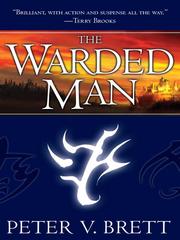
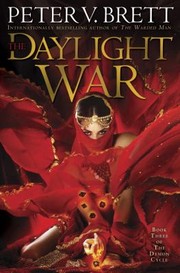
Start with The warded man, and before you buy anything, know that this book has two titles. It was published in the United Kingdom as The Painted Man, and the two are the same novel with the same text. Both appear as separate records in catalogues and shops, including ours, so it is entirely possible to buy the same book twice. Check the author and the description, not the cover.
Read the five main novels in publication order. This is not an arbitrary preference: the cycle is built on a structural gamble that decides how it has to be read. Each volume rewinds and retells part of the previous one from a different character's side, so the antagonist of book one becomes the protagonist of book two, and you are asked to change allegiance while already knowing what is coming. Skip a volume or shuffle the order and that effect collapses into repetition.
The five novels
The warded man establishes the premise: demons rise from the ground every night, wards painted on walls are the only defence, and three children in different corners of a shrinking human world respond to that in three different ways.
The desert spear is the book that defines the series. It rewinds and retells much of book one from the point of view of Jardir, the Krasian leader who betrayed Arlen, and it opens with two hundred pages of Krasian childhood that many readers mistake for a digression. Read it through — everything afterwards depends on accepting the structure.
The Daylight War applies the same move to Inevera, and it ends on the hardest cliffhanger in the series. The Skull Throne is the one volume that breaks the pattern: it moves forward rather than rewinding, and spends most of its length on Krasian and Northern court politics with the two leads largely off the page. It is a pivot, not a failure, but it is the book people warn each other about. The core takes the fight literally underground and resolves the cycle.
A content note
The Krasian culture at the centre of books two onward is built around institutionalised sexual violence, and the cycle depicts rape — including of major point-of-view characters — in scenes that are graphic and bound into the main storylines rather than confined to background. It is not skippable material. The treatment of the series' women is also the thing readers argue about most, particularly from The Daylight War on. Those are facts about the books; whether they are worth it is a judgement.
The novellas
Three are on the reading path and they are genuinely optional, with one near-exception. The Great Bazaar & Brayan's Gold is the combined volume collecting both early Arlen novellas, set between chapters of book one — buying it gets you both, so no separate purchase is needed. Messenger's Legacy is the closest thing to required, because Briar Damaj becomes a significant character in The Skull Throne and The core and this is where he is established; read it after The Daylight War. Barren follows Selia Barren, was published after the cycle finished, and works best as a coda after The core.
The sequel duology
The Desert Prince is set fifteen years after The core and follows the children of the original cast. Brett wrote it to be readable cold and it technically is, but every returning name carries weight only if you have read the five. The Hidden Queen is the second and current volume. Be aware before you start the duology that it is unfinished.
Where to stop
The core is a real ending for the original story. Stopping there is a complete experience; the duology is a continuation, not a conclusion.
Ready to learn something deeply?
Build a reading path — free