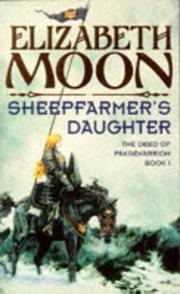
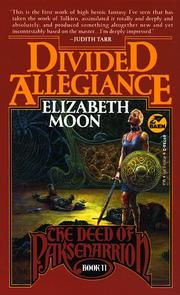
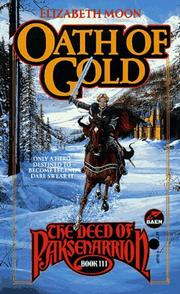
Start with Sheepfarmer's Daughter (The Deed of Paksenarrion). The confusion new readers hit is not about order but about format: The Deed of Paksenarrion is usually sold as a single fat omnibus, so it is genuinely unclear whether you are picking up one book or three. It is three — Sheepfarmer's Daughter (The Deed of Paksenarrion), Divided Allegiance (The Deed of Paksenarrion, Book 2) and Oath of gold, published in 1988 and 1989 and collected shortly afterwards.
Both options are fine and they contain the same text. Our path lists the three individual novels because that is how our catalogue holds them, and the omnibus has no separate record here — search for it and you will be handed the first novel. If you know you want the whole trilogy, the omnibus is usually the cheaper way to buy it; if you want to try one book before committing, buy Sheepfarmer's Daughter (The Deed of Paksenarrion) on its own.
The trilogy, and the slow opening
Sheepfarmer's Daughter (The Deed of Paksenarrion) is famously unhurried. A sheepfarmer's daughter runs off to join a mercenary company, and the book gives you recruit training, marches, camp routine and pay parades at length before anything that looks like a fantasy plot arrives. Moon served in the Marine Corps and it shows in the texture. Most readers find that accumulated ordinariness is precisely what gives the later books their weight — the argument for pushing through is that the payoff is built out of it rather than delayed by it. If military procedure bores you outright, this series will not convert you.
Divided Allegiance (The Deed of Paksenarrion, Book 2) widens into gods, granges and paladins, goes considerably darker, and ends in a failure the third book has to answer. Read it without a gap. Oath of gold resolves that failure and contains the sequence readers still cite decades later; it makes very little sense on its own.
The Gird prequels — fourth, not first
Surrender None (Legacy of Gird) tells the life of Gird, the peasant revolutionary whose religion the trilogy treats as scripture. Chronologically it precedes the trilogy by centuries. Read it fourth anyway. The entire effect is recognising the man behind liturgy you have already heard Paks recite, and reading it first converts a revelation into an introduction.
Liar's Oath (The Legacy of Gird #2) follows Gird's successor Luap into the aftermath and the long compromise, and it is a markedly less comfortable book. These two are sometimes packaged together as The Legacy of Gird; that omnibus is the same pair of novels, has no record of its own in our catalogue, and is again usually the cheaper purchase if you want both.
Paladin's Legacy — the return
Twenty years later Moon wrote five more books, and the crucial thing to know is that they are a sequel to the world rather than to the character. Oath of Fealty (Paladin's Legacy #1) opens immediately after Oath of gold with Kieri Phelan and Dorrin Verrakai at the centre; the change of lead is permanent. Kings of the north widens to the northern kingdoms and elven politics. Echoes of betrayal is the volume that most rewards having read the Gird books, because the deep history stops being background. Limits Of Power is largely a long approach to the finale. Crown of renewal ends the sequence and ties off threads left hanging since Oath of gold.
Where to stop
After Oath of gold is a complete and satisfying stopping point, and many readers stop there. The full ordered sequence, with what each stage is for, is on the reading path.
Ready to learn something deeply?
Build a reading path — free