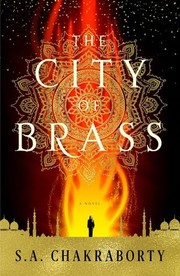
Start with The City of Brass. There is no competing order to argue about here — the Daevabad books are a three-volume story published in sequence, each volume opening where the last one closed, and reading them in publication order is reading them chronologically. The obvious alternative, starting with the standalone set in the same world, is worse for a specific reason given below. The only genuine questions are where the two extra volumes go, and whether you need any background before you begin.
One practical note before you go looking for the author. The covers say S. A. Chakraborty; our catalogue files every one of these under Shannon A. Chakraborty. That is the same writer, not a different edition or a co-author.
The three novels
The City of Brass opens in eighteenth-century Cairo with Nahri, a young con artist running fake exorcisms in the street, whose fakery turns out not to be fake at all. What follows is a journey to a hidden brass city she has no idea she belongs to, and an education in six tribes of djinn who have been at each other's throats for centuries. It is the most conventional of the three — a discovery plot, a road, an arrival — and it is doing the necessary work of teaching you a political system you will need later.
The Kingdom of Copper: A Novel (The Daevabad Trilogy) jumps five years and is a much more political book. Nahri is inside the court and constrained by it; Ali is in exile. The betrayal at its centre only lands if the first book's ending is still fresh, which is the practical argument against a long gap between the two.
The Empire of Gold is the conclusion, and it pays off the djinn-and-daeva history the first two books spend their length arguing about. It is long. It also genuinely ends: this is a finished trilogy, not a series left open for sequels, which is worth knowing when you decide whether to start.
Where the two extras go
River of Silver — published as The River of Silver — is a collection of deleted scenes, side stories and one substantial epilogue. Several of them spoil the trilogy outright, and the collection has almost no value to a reader who has not finished The Empire of Gold. Read it fourth or not at all. Do not treat it as a prequel because some of its contents are chronologically early.
The Adventures of Amina Al-Sirafi is set in the same world several centuries earlier and follows a retired pirate captain pulled back for one last job. Chakraborty wrote it to be read cold, and it works cold. The reason not to start with it is simply that it is the beginning of a different sequence, and a reader who wants Daevabad will get a nautical adventure with a middle-aged mother at the centre instead. Treat it as the natural next book rather than as a fifth volume of the trilogy.
The tradition the books are working inside
The trilogy assumes a reader who knows that jinn are a theology rather than a lamp gag, and two books on our path supply that. One Thousand and One Nights is the Lebanese novelist Hanan al-Shaykh's retelling of nineteen of the tales, written for the stage and far closer to the tales' actual register than the Victorian translations most English readers encounter first. Islam, Arabs, and the intelligent world of the jinn is a scholarly account by Amira El-Zein of the jinn as a genuine third order of creation in Islamic cosmology. It is the book that most changes how the trilogy's theology and its ethnic politics look on a reread, which is why it belongs at the end rather than the start.
Where to stop
After The Empire of Gold is a legitimate stopping point and a complete experience. Everything after it is optional in a way the three novels are not.
Ready to learn something deeply?
Build a reading path — free