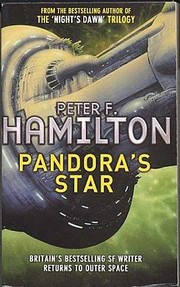
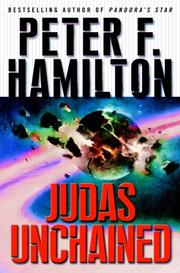
Start with Pandora's Star, 896 pages. It opens the wormhole-linked human civilisation, the Dyson Pair anomaly and the Starflyer conspiracy, and every later Commonwealth book assumes you already know all three. Then read Judas Unchained, 842 pages, immediately afterwards. Those two are not a book and its sequel — they are one novel split for length, and every thread the first opens is resolved in the second. Stopping between them leaves the story literally unfinished, so treat them as a single commitment of close to eighteen hundred pages.
The common mistake is starting with The Dreaming Void, 651 pages, because it opens a trilogy and looks like a fresh beginning. It is not. It picks up a Commonwealth transformed by post-human factions fifteen centuries after the duology, and its structure only makes sense if you know what the Commonwealth was before.
The duology
Pandora's Star is a slow build with a very large cast and takes several hundred pages before the shape of it appears; that is the price of entry and it is the reason people give up. If the first two hundred pages feel like an anthology of unrelated lives, that is deliberate, and they converge. Judas Unchained pays all of it off.
The prequel and the short fiction
Misspent Youth, 386 pages, is chronologically first — it introduces Jeff Baker, whose rejuvenation technology underwrites the entire Commonwealth — but read it third rather than first. Before the duology it is a small domestic novel that reads as a curiosity; after it, it is a foundation stone. Manhattan in Reverse, 272 pages, is a collection whose best pieces are Commonwealth stories, including two Paula Myo investigations. Several of them spoil the duology outright, so it belongs after, not before.
The Void trilogy
The Dreaming Void alternates between the post-human Commonwealth and Edeard's story inside the Void, and readers split hard on the Edeard sections — they read as pastoral fantasy inside a space opera. The Temporal Void, 709 pages, is where that thread turns into the trilogy's actual argument about what the Void is for, and it converts most of the doubters. The Evolutionary Void, 672 pages, resolves both narratives and pays off decisions made in Judas Unchained.
This is the natural place to stop. Five books in, you have a complete Commonwealth story with a real ending.
The Chronicle of the Fallers
The Abyss Beyond Dreams, 627 pages, sends Nigel Sheldon from the duology into the Void, which places it chronologically inside the Void trilogy while depending entirely on knowing how that trilogy ends. Read it after, never before — this is the one place where chronological order actively damages the books. Night Without Stars, 711 pages, concludes the Fallers story generations later on the same world and is the last Commonwealth book to date.
Where Hamilton readers go next
The Reality Dysfunction, 609 pages, opens the Night's Dawn trilogy in a separate universe, and is where most Commonwealth readers go. It is bigger, wilder and considerably more horror-inflected, and it is the right entry point for that sequence rather than anything later in it. Fallen Dragon, 630 pages, is a standalone and the shortest route to finding out whether Hamilton's style suits you at all — useful as a palate cleanser between the long sequences, or as a trial run before committing to Pandora's Star. Salvation, 552 pages, opens his later Salvation Sequence, which reuses the wormhole-network idea from a colder angle in a distinct universe; read it as a fresh start rather than as more Commonwealth.
A word on what you are signing up for. These are long books with very large casts, multiple simultaneous plotlines and a habit of introducing a new viewpoint character four hundred pages in. Hamilton writes hard-SF spectacle rather than prose style, and readers who want the latter tend not to get on with him. If the first hundred pages of Pandora's Star do not work for you, the remaining seven thousand will not either.
The staged order, with what each book does, is at the Commonwealth reading path.