Alfred Crosby coined the phrase in 1972 for something historians had somehow not made central: the most consequential cargo moving across the Atlantic after 1492 was biological. Maize, potatoes and cassava went east and eventually underwrote a doubling of the Old World's population; wheat, cattle, pigs and sugar came west; and smallpox, measles and typhus came with them into populations with no acquired immunity.
The reading order matters more here than in most subjects, and it matters most in the middle. The size of the American demographic collapse is genuinely disputed — estimates of the pre-contact population run from roughly eight million to over a hundred million — and the books that argue about it only make sense in sequence. Read the sceptic before you have seen how the estimates are actually constructed and he sounds merely contrarian; read him after and his objection is specific and hard to dismiss.
The two books that make it a story
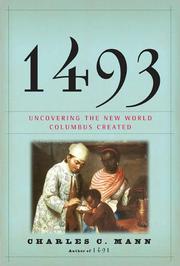
Charles Mann's 1491 (632 pages) surveys what the Americas were before contact: larger populations than twentieth-century textbooks allowed, engineered landscapes in Amazonia, cities in the Mississippi valley. It is journalism about scholarship rather than scholarship, and it is scrupulous about telling you where the experts disagree, which is exactly what you want first. Its sequel, 1493 (560 pages), is the one directly about the exchange — silver to China, the potato and guano in Europe, malaria and yellow fever determining who could work where, earthworms remaking North American forests. Both titles are bare years, so they appear here in plain text rather than italics.
Crosby, who named the thing
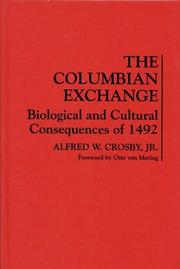
The Columbian exchange (283 pages, 1972) is short, readable, and still the reference; Crosby could not place it with a major press at the time. Our catalogue lists his name three times on the record, including an inverted library form — one author, not three. Ecological Imperialism (384 pages, 1986) is the bigger and more contentious follow-up: Europeans succeeded permanently only in the temperate neo-Europes — North America, Argentina, Australia, New Zealand — where their crops, weeds, livestock and diseases could establish. It has been criticised for determinism, and it is worth testing against everything that comes after it.
The collapse, in the order it has to be read
Born to die (Noble David Cook, 248 pages) is the standard account of disease in the Americas from 1492 to 1650, epidemic by epidemic, and unusually good at showing which outbreaks are documented and which are inferred. Plagues and Peoples (William McNeill, 340 pages) supplies the framework — the virgin-soil epidemic — that everything else here argues about; its idea has aged better than its numbers. The Native population of the Americas in 1492 (353 pages) is the essential reference on the estimates themselves, a collection in which specialists work through the evidence region by region, with William Denevan's own synthesis of roughly fifty-four million. This is where you watch a hemispheric figure actually being built, out of multipliers and assumptions.
Only then read Numbers from nowhere (David Henige, 532 pages), which argues that high-counter methodology is largely unfalsifiable — a depopulation ratio applied to a thin source produces a number with no real evidential basis. Henige is cranky and methodologically serious, and the objection only lands if you have seen the construction he is objecting to. At the far end of the range, David Stannard's American Holocaust makes the opposite case; it is not in our catalogue, so it is named rather than listed. The stage closes with Epidemics and enslavement (Paul Kelton, 301 pages), the most important recent revision: smallpox in the Southeast did not become catastrophic until the commercial Indian slave trade concentrated, displaced and starved people. That reframes the whole subject, because it makes the collapse a product of colonialism's specific violence rather than of microbes acting alone.
The crops, and one region in close-up
America's First Cuisines (276 pages) reconstructs what Aztec, Maya and Inca people actually ate — you cannot judge what the exchange gave the Old World without knowing what it was taken from. The true history of chocolate (280 pages) follows cacao from ritual beverage to European luxury to industrial commodity, and is the most enjoyable book on the list. The potato (304 pages) is the best single demonstration of the abstract claim about calories and population: suspicion, adoption, dependence, famine.
Changes in the land (William Cronon, 249 pages) shows the exchange at the scale of New England — fences, livestock, timber, and the imposition of property in land on a system that had not had it. Pox Americana (Elizabeth Fenn, 384 pages) ends the path with the continental smallpox epidemic of 1775 to 1782, which killed far more people than the Revolutionary War it moved through. The staged sequence, with study plans, is at /paths/pt_ai_the-columbian-exchange.