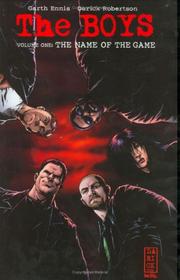
Start with The Boys Vol. 1, 152 pages, collecting the arc called The Name of the Game: Hughie's recruitment, Butcher's CIA remit and the Compound V premise. Garth Ennis and Darick Robertson's series ran seventy-two issues collected as twelve slim trades, and it reads in exactly one order — straight through, with Herogasm and the Highland Laddie arc in their numbered slots rather than treated as optional spin-offs.
Two things to know before you buy. First, the comic is deliberately extreme: graphic sexual violence, sexual humiliation, torture and gore are used as satire throughout, and Ennis does not soften any of it. Second, it diverges permanently from the television adaptation after roughly the first volume, and the comic's ending is not the show's ending. If you are coming from the series expecting the same story with more swearing, that is not what this is.
Which volumes we can link, and which we cannot
This path stays inside the twelve-trade numbering rather than the six-volume omnibus line, because mixing the two either gaps or double-counts. Our catalogue holds volumes 1, 2, 5, 6, 9, 10 and 12, which leaves three separate gaps. Searching for The Boys, Vol. 3 in our catalogue returns an omnibus instead — a different collected tier, and including it would double-count material.
The missing trades are volume 3 (Good for the Soul) and volume 4 (We Gotta Go Now); volume 7 (The Innocents) and volume 8 (Highland Laddie); and volume 11 (Over the Hill with the Swords of a Thousand Men). Highland Laddie is the one worth going out of your way for — it is Hughie's solo story, the quietest thing in the series, and it belongs between volumes 6 and 9. Read those five from a library or your own set as you reach them.
The order
The Boys Vol. 1 is the premise. The Boys, Vol. 2, 192 pages, is Get Some, the first arc that is entirely Ennis rather than setup, and the point where the satire stops being about superheroes and becomes about institutions.
Then the two library gaps, then Garth Ennis' the Boys Vol. 5. This is Herogasm, which the show treats as a standalone event and the comic treats as plot — it is numbered as volume 5 of the main series and belongs in that slot, not afterwards. Our record holds no page count for it. Garth Ennis' the Boys Vol. 6 is The Self-Preservation Society, which finally gives the Boys themselves the backstory the first five volumes withhold, and where the series turns from satire toward tragedy. Its cover art is by Carlos Ezquerra rather than Robertson, which our record reflects.
Garth Ennis' the Boys Vol. 9 is The Big Ride, restarting the main plot after two character-focused volumes. The Boys, Vol. 10, 144 pages, is Butcher, Baker, Candlestickmaker — Butcher's origin, told straight, and the single volume that most changes how the series reads. Do not skip it as a flashback. The Boys, Vol. 12, 170 pages, is The Bloody Doors Off, the actual ending, and the clearest demonstration of how far the comic sits from the show.
What the adaptation changes
The show follows volume 1 fairly closely and then goes its own way. Broadly: the television Homelander, Butcher and Hughie are recognisable, most of the supporting cast is not, several characters who die early in the comic survive for seasons, and the endgame — Butcher's actual plan, which surfaces in the last third — has no television equivalent. Herogasm is an event in the show and an arc in the comic. Read the comic as a separate work.
Ennis without the capes
Preacher, Vol. 1, 200 pages, is the book The Boys is constantly compared to and the one that established the road-trip structure, the profane comedy and the sentimentality underneath. Preacher Vol. 2, 254 pages, brings in the supporting cast that makes it work; the first two volumes are a single setup, so read both before deciding on the other seven. More on that series sits at Preacher.
Hitman by Garth Ennis and John Mccrea Omnibus Vol. 1 is the earliest Ennis book doing what The Boys does — superhero satire with real affection underneath — and the funniest of the three; we hold it as the omnibus rather than the individual trades. Marvel Knights Punisher by Garth Ennis, 440 pages, is the blackly comic Punisher run and the clearest ancestor of the tone before Ennis had a creator-owned book to put it in.
The full stage order is at the Boys reading path.