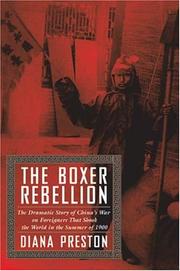
The Boxer Rebellion has an unusually lopsided literature. Because foreigners were besieged in Peking for fifty-five days and many of them wrote it up afterwards, there is a large, vivid, first-hand record of a small part of the event and a much thinner popular record of everything else — the drought, the missionary conflict in rural Shandong, the court politics, and the punitive campaign that followed the relief.
Reading in order fixes that imbalance. Start with the narrative because it is genuinely gripping and you need the sequence of events in your head. But do not stop there, because the siege is where the older books end and the interesting scholarship begins.
The narrative
The boxer rebellion by Diana Preston is the standard popular account, built substantially on diaries and letters from inside the legations, and it moves. The Boxer Rebellion and the great game in China by David Silbey is the better one on the military and international side — the eight-nation expedition, the logistics, and the fact that this was a multinational invasion of China conducted by powers that did not trust one another.
The siege at Peking by Peter Fleming is the readable older classic, written in the 1950s, and it should be read with its date in mind. Its handling of the Chinese participants reflects the assumptions of the period it was written in, and it has aged noticeably worse than the two books above.
Then the origins
The origins of the Boxer Uprising by Joseph W. Esherick is the pivotal scholarly work and the one that changed the field. It traces the movement to specific conditions in western Shandong — sectarian and martial-arts traditions, a drought, a disputed church, and a foreign presence backed by extraterritorial privilege — rather than to generalised xenophobia. If you read one academic book here, read this one.
Origins of the Boxer War by Lanxin Xiang approaches the same question through diplomacy and the Qing court, and reaches conclusions Esherick does not. The Missionarys Curse And Other Tales From A Chinese Catholic Village by Henrietta Harrison — the apostrophe has gone missing from our catalogue record — follows one Catholic village across centuries, and it is the book that makes the religious conflict at the heart of this concrete rather than abstract.
The empire that produced it
The Scramble for China by Robert Bickers is the essential background: the treaty ports, the concessions, the gunboats, and the accumulated humiliations of the nineteenth century that the Boxers were reacting against. Read it and the uprising stops looking irrational.
The Qing court is the other half. Empress Dowager Cixi by Jung Chang argues that Cixi was a reformer badly served by history, and Dragon Lady by Sterling Seagrave argues, from a different direction, that the familiar image of her was largely manufactured by a Western journalist and a forger. Chang's rehabilitation is disputed by many academic historians of the Qing, who consider it selective with the evidence; her defenders say the older consensus was itself built on hostile sources. Both books are on this path deliberately, and the argument between them is not one we will settle for you.
Finally, the meaning
History in three keys by Paul A. Cohen is the book to finish on, and it is a genuine masterpiece of historical method. It takes the Boxers three times over: as an event historians reconstruct, as an experience the participants lived without knowing the ending, and as a myth that Chinese and Western politics have both used ever since. It will change how you read every other book on this list.
The Boxers, China, and the World is an edited collection — our record credits only Robert Bickers, but it gathers a range of specialists — and it is the natural follow-on, covering the international and comparative dimensions.
If the pattern of anticolonial revolt interests you more than China specifically, the reading path on the Indian Rebellion of 1857 covers a comparable event with a comparably contested name.
The full ordered path, stage by stage, is below.
Follow the full ordered path here: The Boxer Rebellion: Books to Read, in Order.