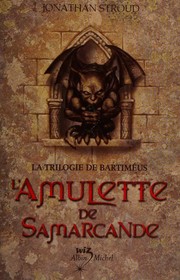
Start with The Amulet of Samarkand, 462 pages. A twelve-year-old magician's apprentice in an alternate imperial London summons a five-thousand-year-old djinni to steal an amulet, and the book alternates between the boy's third person and the djinni's sardonic, heavily footnoted first. It is the only correct entry point, because everything the sequence does later depends on meeting Bartimaeus this way.
The one real decision is where to put The Ring of Solomon, 448 pages. It is set two thousand years before the trilogy and was published five years after it ended, which makes it look like the obvious opener. It is not. The trilogy's emotional payload is a slow reveal about Bartimaeus's memory of a boy called Ptolemy, and the prequel takes that reveal for granted from its opening pages. Read the three novels first and The Ring of Solomon fourth, where it works as an epilogue that happens to be set in 950 BC. Our record for it lists Jonathan Stroud twice, once misspelled, which is a catalogue artefact rather than a co-author.
The trilogy, in publication order
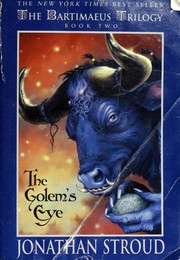
The Amulet of Samarkand is a heist with a hostile narrator. The Golem's Eye, 576 pages, widens the world: a third narrator arrives from the Resistance, and the politics of the magicians' government stop being background. It is the longest of the three and the volume readers most often stall in, because a caper turns into a story about an empire. Push through it. Ptolemy's Gate, 522 pages, is what the first two exist to make possible — the Ptolemy material surfacing in footnotes since book one finally becomes the plot, and the ending is the reason people remember this series into adulthood.
That is a complete story. If you stop after Ptolemy's Gate you have lost nothing.
Lockwood and Co., in order
Stroud's other complete series is the better-plotted of the two: a London where only children can see ghosts, and a three-person agency with no adult supervision. The five books are one continuous arc, so read them straight through. The Screaming Staircase, 418 pages, establishes the agency. The Whispering Skull, 464 pages, introduces the talking skull, which becomes the series' equivalent of Bartimaeus — the rude, unreliable commentary that makes the horror bearable. The Hollow Boy, 448 pages, breaks the trio's dynamic on purpose and starts the overarching mystery moving. The Creeping Shadow, 512 pages, is the darkest instalment and ends on the sharpest cliffhanger. The Empty Grave, 480 pages, answers the question the five books have circled and does not soften it.
These are genuine horror for younger readers — the hauntings are frightening rather than atmospheric, and children die in them.
Stroud before Bartimaeus
The three early novels are folk horror rather than comic fantasy, and reading them is a different experience from the footnotes. Buried fire, 308 pages, is his first, about a dragon under an English hillside and a village that starts to change. The Leap, 213 pages, is a girl convinced her drowned friend is alive somewhere else, told in two alternating voices, one of which may be a delusion — the most unsettling thing he has written. The Last Siege, 297 pages, has three children occupying a derelict castle in midwinter until the game turns real. It appeared the same year as The Amulet of Samarkand and is completely unlike it.
The two standalones
Heroes of the valley, 402 pages, is a Norse-flavoured book written between the two series, in which the sagas the hero grew up on turn out to be badly wrong about what happened. It is the least-read thing in his catalogue and the funniest he has written about storytelling itself. The Outlaws Scarlett & Browne, 448 pages, is his post-Lockwood series opener — a bank robber and a strange boy crossing a broken, half-flooded future Britain. It is the first of an ongoing sequence rather than a finished one, so read it last.
The stage-by-stage order is at the Bartimaeus reading path.