Start with Shogun, and read the six novels in the order their events happen rather than the order Clavell wrote them. Shogun is an English pilot wrecked on the coast of Japan in 1600, based on the real William Adams; it is both the earliest event in the saga and its best book, and nothing else Clavell wrote teaches a foreign social system from the inside as well. The obvious alternative is publication order, which would open on King Rat — a short, bleak prison-camp novel that is unlike the other five and a poor advertisement for what the saga does.
The two orders diverge sharply. Clavell published King Rat first, then Tai-Pan, Shogun, Noble House, Whirlwind, Volume One and finally Gai-Jin in 1993. By setting the sequence is Shogun (1600), Tai-Pan (1841), Gai-Jin (1862), King Rat (1945), Noble House (1963) and the Iranian revolution of 1979. The ordered list with stage notes is on the Asian Saga path.
Why chronological wins here
Because the saga is held together by a trading house, not by a theme. The Struan company is founded in Tai-Pan and inherited forward; Noble House is a family story about people whose ancestors you met a hundred and twenty years earlier, and it is substantially weaker read cold. Gai-Jin is a direct sequel to Tai-Pan that most readers never realise exists, because it was published twenty-seven years later and last. Chronological order also happens to put the strongest book first, which publication order does not.
The honest case for publication order is that it shows a writer developing — King Rat is drawn from Clavell's own three years as a prisoner of the Japanese, and reading it first makes the later romance of the tai-pans look like a deliberate retreat from it. That is a real argument, and it is the better second pass. For a first read, take the settings.
The books, and how long they are
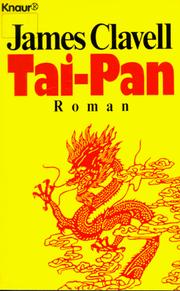
Shogun is 1,136 pages in our record. Tai-Pan is 663 pages and is the load-bearing book of the saga: Hong Kong in 1841, immediately after the First Opium War, and the founding of the trading house. Gai-Jin is 1,232 pages, set in Yokohama in 1862 with the grandchildren of the earlier cast and Japan on the edge of the Meiji Restoration. King Rat is 391 pages of Changi camp in 1945 and the harshest thing here. Noble House is 1,174 pages covering a single week of financial warfare in 1963 Hong Kong, and it is the book that most rewards having read the saga in this order.
Then the trap. Our record for the Iran novel is Whirlwind, Volume One — the edition splits the novel in half, so it is not a complete book and you will need the second volume separately. Buy it knowingly or find a single-volume printing.
Two warnings about the editions
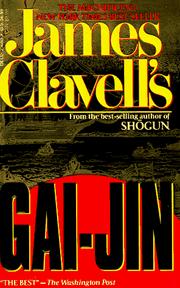
Several records behind these English display titles are foreign-language editions: the Gai-Jin record carries a German ISBN, Noble House a Mexican one and Whirlwind, Volume One a Russian one. Check the listed language before ordering.
And The children's story is not part of the saga at all. It is a very short fable about a new teacher taking over an American classroom after a conquest, and our record is a 93-page illustrated edition of a text that runs to a few thousand words. It is worth reading — it states plainly the theme underneath all six novels, how quickly people can be persuaded to give up what they believed — but do not buy it expecting a novel.
Reading the novels against the record
Learning from Shōgun is a 163-page collection of essays by Japan historians written in 1980 in direct response to the novel and the miniseries, sorting what Clavell got right from what he invented; it exists because the book taught more Americans about Japan than any course did. Samurai William is a narrative biography of the real pilot Blackthorne is based on. The Opium War tells the war that Tai-Pan opens just after from both British and Chinese sources, which matters because Clavell's traders are heroes and this is what they were trading. Hong Kong is Jan Morris's history of the colony from the barren rock of 1841 to the run-up to the handover, and it covers the saga's entire span in one continuous account.
Where to stop
Most readers rate Shogun highest and a large number never go further, which is a defensible place to stop. If you want two, add Tai-Pan. If you want the payoff the structure was built for, you need Tai-Pan and Noble House as a pair.