Start with Time of hope. It is the chronological opening of C. P. Snow's eleven-novel sequence, and it establishes the narrator Lewis Eliot as a poor, ambitious young man in a Midlands town — the fact every later book quietly depends on when it puts him in a Cambridge combination room or a Whitehall office.
The obvious alternative is The masters, which is the most admired novel Snow wrote and is entirely self-contained: a dozen dons manoeuvring over the election of a new college head, and one of the best novels in English about how small institutions actually make decisions. Plenty of readers start there, and if you are unsure whether Snow's manner suits you, it is the right book to test on. But it introduces Eliot as a settled insider, and the sequence works far better if you have watched him arrive.
Publication order or chronological order
This is the genuine controversy with Strangers and Brothers, and unusually the author settled it himself. The novels appeared between 1940 and 1970 in an order that scrambles Eliot's life: the fourth-published book covers events before the second, and the sequence's opening volume in narrative terms was published ninth.
Snow attached a note to later editions recommending that readers take them in the order of Eliot's life rather than of publication, and this reading path follows that recommendation. The case for it is simple — the books were conceived as one design, and read chronologically the recurrences of character and theme accumulate as intended rather than arriving as flashbacks.
The case for publication order is not empty. You see Snow's technique develop, and the first book published, now titled George Passant, originally carried the title Strangers and Brothers and gave the whole sequence its name. If you are reading Snow as a literary historian, that matters. For everyone else, read chronologically.
The early sequence
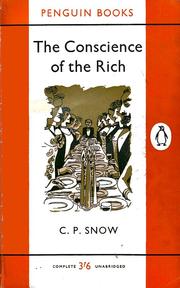
After Time of hope comes George Passant, about a provincial solicitor's clerk with a following of young people and a talent for self-destruction — the most vivid character Snow created. The conscience of the rich turns to a wealthy Anglo-Jewish family and a son's break with it, and The light and the dark follows a brilliant, self-destructive Cambridge orientalist through to the war.
An honest warning: these two are the slowest in the sequence for many readers, and The conscience of the rich in particular takes a long time to declare its subject. If you stall, push on to The masters rather than abandoning the series.
The institutional novels — the heart of it
The masters is the peak. The new men follows the British atomic bomb project and the moral position of the scientists inside it, and it is the book that most directly connects to Snow's own career and to the argument about science and literature he became famous for. Homecomings returns to Eliot's private life and his marriages, and is the most emotionally direct book here.
The Affair revisits the college of The masters twenty years on, this time over a disputed dismissal and a possible fraud. It is the most satisfying late novel and a legitimate stopping point if the sequence is losing you.
The late books
Corridors of power gives the sequence its most quoted phrase and takes Eliot into ministerial politics and a defence controversy. The sleep of reason is the darkest of the eleven, built around the trial of two women for the torture and murder of a child; the material is drawn from a case that had recently horrified Britain, and the novel is not gentle with it. Last things winds the whole design down, deliberately quietly.
What to expect, and what critics say
Snow's prose is plain, unmetaphorical and slow, and this is where opinion splits sharply. Admirers regard the flatness as the point — a narrator whose reticence is a character trait, applied to institutions nobody else was writing about. Detractors have called it dull, and the most famous attack, delivered by F. R. Leavis in 1962 in the course of a much broader quarrel, disputed that Snow could write novels at all. Snow's critical standing has never recovered from that exchange, and whether it deserved to is still argued over.
Two other things are fair to say. The world of these books is overwhelmingly male and institutional, and the women in them are drawn thinly by comparison. And the eleven novels are all present in this path, which is not always true of a sequence this long. Browse more series reading orders.
Follow the full ordered path here: Strangers and Brothers Reading Order: Where to Start.