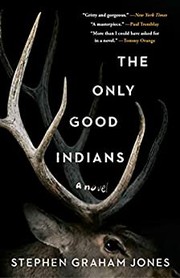
Start with The Only Good Indians: four Blackfeet men hunted by what they did on a hunt ten years earlier. It is his most controlled novel, it works with no prior reading, and it is the book where the horror and the argument about Indigenous life are the same object rather than two things bolted together. If you want the same writer at his warmest, start with Mongrels instead — a family of werewolves living in trailers across the American South, narrated by a boy waiting to turn. Either is a legitimate entry point; the rest of this order assumes one of the two.
Why not simply start at the beginning? Because Stephen Graham Jones has published something over thirty books in twenty-five years, much of it through small presses, and the quality genuinely varies. Reading chronologically means opening with the hardest and least representative work. The ordered version of everything below is on the Stephen Graham Jones path.
The Indian Lake trilogy
This is the major work, and it must be read in sequence. My Heart Is a Chainsaw follows Jade Daniels, a slasher-obsessed teenager in a lake town, narrating a real slasher through the grammar of the films; it is slow for its first third on purpose and the payoff depends on that patience. Don't Fear the Reaper picks up years later, is faster and more brutal at 464 pages, and assumes you remember everything. The Angel of Indian Lake closes the trilogy at length and is the most divisive of the three — it decides retroactively what the whole sequence was about, and readers split on whether that landing works.
The novellas
Mapping the Interior is 111 pages about a boy who sees his dead father moving through the house, and it does more with Indigenous grief than most novels manage. Night of the Mannequins is 136 pages in which a prank escalates into something the narrator cannot stop explaining away; structurally it is the nastiest trick he has pulled off. Both take an evening, and both are good tests of whether the longer books are for you.
The small-press books worth hunting
These are harder to find and considerably harder to read. The Last Final Girl is a slasher novel written in screenplay-adjacent present tense, all camera direction and hard cuts — formally the most extreme thing he has done. Demon Theory presents a horror-film trilogy as a 441-page novel with several hundred footnotes; read it as an experiment rather than a story, because as a story it is exhausting. The Least of My Scars is a serial killer kept in an apartment by a patron who feeds him victims, and it is his bleakest book by a distance. Ledfeather is the most literary novel here: a Blackfeet reservation across two time periods, told in fragments, with almost no horror in it, and it is frequently named his best by critics who do not otherwise read the genre.
The early and the newest work
The fast red road, published as The Fast Red Road: A Plainsong, is the 2000 debut — a pop-culture-saturated Indian Country picaresque, hard going, and useful mainly for seeing where the voice started. Growing Up Dead in Texas is autofiction about a cotton-gin fire in the town he grew up in, with the author as investigator; it is his most personal and least generic book. Buffalo Hunter Hunter is the recent novel, a vampire narrative nested inside a Lutheran pastor's journal and built around the Marias Massacre; our record files it without its leading article.
Two things about the records, and one about the books
Our catalogue records for The Only Good Indians and Mongrels co-credit an audiobook narrator and two Spanish translators alongside Jones. Those are edition artefacts; both works are his.
The horror is graphic. Animal death, mutilation, sustained torture and killings described in close detail are all present, and The Least of My Scars in particular spends its length inside the head of a man doing them. Jones does not use distance as mercy. If that is the problem, Mapping the Interior and Ledfeather are the two books here that are closest to grief novels. More horror reading orders are on Discover.
Ready to learn something deeply?
Build a reading path — free