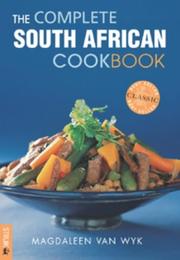
Start with The Complete South African Cookbook and treat it as a lookup volume rather than something to read through. Magdaleen van Wyk covers every tradition in the country at once — bobotie, bredies, pap and chakalaka, boerewors, melktert — which is what you want before you know which tradition you are actually interested in.
The reason order matters here is that South African food is not one cuisine. It is Cape Malay spicing, Afrikaner farm cooking, Xhosa and Zulu home food, Durban Indian curry and the braai, all of which have been arguing in the same kitchen for three centuries. This path takes the everyday household repertoire first, then the Cape Malay tradition that supplies most of what makes the food taste specific, then fire, then the historical and African-language sources, then the continent.
The week's cooking
Cook and Enjoy It is the English edition of the Afrikaans household bible Kook en Geniet, first published in 1951 and still in print. Our catalogue holds both language editions as separate live records, so buy one and not both — they are the same book. This is the canonical text for koeksisters, melktert, bredies and preserving.
Through the Eyes of an African Chef is the corrective, and it sits third deliberately. Nompumelelo Mqwebu writes indigenous South African ingredients and Zulu and Xhosa dishes as a professional cuisine rather than as folklore, and you will only see what the two older books leave out once you have met them.
Cape Malay
The Cape Malay Cookbook is the key regional text: Faldela Williams recording the Bo-Kaap community's recipes without simplifying them. She also wrote a sequel, More Cape Malay Cooking, which is a different book — start with this one.
My Cape Malay Kitchen tells the same tradition as family memoir. Cariema Isaacs is far better than Williams on why a dish is cooked when it is — Ramadan, funerals, weddings — and on the technique the older book assumes you already have. Read it as the context for Williams's recipes rather than instead of them.
Karoo kitchen moves that cooking inland, where the meat is mutton and the spice trade is a long way off. Sydda Essop is the best book here on slow lamb, and a good demonstration that the tradition adapts rather than sitting still.
The fire
Three braai books doing three different jobs. Fireworks is Jan Braai on the technical grounding — building a wood fire, coal management, cuts, timings, and the sides that go with them. Braai the beloved country is broader and more regional, and much better on game, coastal seafood and potjie. Cooked in Africa is Justin Bonello cooking outdoors across southern Africa, which puts the fire back in a landscape rather than a suburban garden.
Where the food came from
Hilda's "Where is it?" of recipes was published in 1891 and is the founding Cape cookbook in English — the earliest usable record of most of the dishes above. Read it as a colonial-era document. The labour that produced this food is almost entirely invisible in its pages, which is itself the information.
First catch your eland is Laurens van der Post on southern African ingredients and hunting, and the most literary writing on the list. His accounts of San and rural life are contested and he is a compromised narrator; the material on veld ingredients is still worth having, but do not treat him as an ethnographic source.
Ukutya Kwasekhaya is Nelson Mandela's personal cook, Xoliswa Ndoyiya, writing Xhosa home food under an isiXhosa title meaning food from home — umngqusho, samp and beans, umleqwa. It is the most direct record here of a Black South African home kitchen, and the answer to what the older cookbooks leave out.
The continent around it
The Africa cookbook is Jessica B. Harris's continent-wide survey and the standard English-language reference. Read the southern African chapters against everything above, then the West African ones to see how differently the same staples get handled — that comparison is why /subjects/west-african-cooking is worth a look next.
In Bibi's Kitchen closes the path with grandmothers from eight African countries on the Indian Ocean, South Africa among them, cooking in their own words. It is where the Cape's spice, rice and dried fruit stop looking like an anomaly.
One honest gap: there is no dedicated book here on Durban Indian cooking, one of the country's four major traditions. The full ordered path, with the stage goals and what to cook from each book, is at /paths/pt_ai_south-african-cooking.