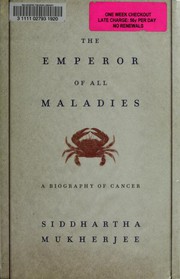
Start with The Emperor of All Maladies. It is his first full-length book, it is the best of them, and it establishes the method the later two reuse: a history of an idea told through the clinicians who had it, interleaved with cases from his own oncology fellowship.
The tempting alternative is The laws of medicine, which is about ninety pages and looks like a sensible sample. It is the wrong first move. It is a short essay from a talks series, it is the slightest thing he has written, and judging him by it would put you off a much better writer. Read it later or not at all.
Note before going further: these are histories and works of popular science, not clinical guidance. Nothing in any of them is a substitute for a conversation with a doctor about your own situation, and Mukherjee says so himself repeatedly.
The big three, in publication order
The Emperor of All Maladies runs to about six hundred pages on the history of cancer — from the earliest surgical descriptions through radical mastectomy, the first chemotherapies, the tobacco fight and targeted therapy. Its strongest sections are on Sidney Farber and on the political campaign that produced the National Cancer Act, and its best quality is that it does not tidy up the dead ends.
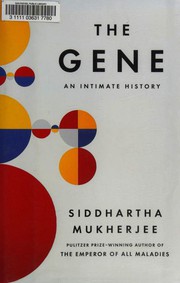
The Gene is the sequel in structure: heredity from Mendel through the molecular era to editing. It is more argumentative than the first book, and the family history running through it — mental illness across several generations of his own family — gives it a personal spine. The book's treatment of what genetics can and cannot say about behaviour and identity drew substantial criticism from working geneticists when it appeared, some of it sharp. Read it aware that the field disputes parts of the framing rather than taking the synthesis as settled.
The Song of the Cell is the most recent and, by fairly general agreement, the most diffuse. The cell is a harder organising subject than cancer or the gene — it is everything at once — and the book covers immunology, transplantation and neurons without the narrative spine the other two have. Read it third or skip it.
The laws of medicine belongs at the end as a coda. It is genuinely interesting on uncertainty and clinical reasoning; it is just not a book on the scale of the others.
The companion reading, which is where the arguments live
The Immortal Life of Henrietta Lacks by Rebecca Skloot is the necessary counterweight to any triumphal history of cell biology: the HeLa line, the woman it was taken from without her knowledge, and what her family were and were not told for decades.
The death of cancer is by Vincent T. DeVita Jr. — our catalogue records the author name awkwardly — written with Elizabeth DeVita-Raeburn. DeVita ran the National Cancer Institute and helped develop combination chemotherapy, and his account is far more combative than Mukherjee's about the institutional politics of oncology. Reading the two against each other is genuinely instructive; they disagree.
Genome by Matt Ridley takes one gene from each chromosome as its structure. It predates the completed human genome sequence and parts of it have dated, particularly on behavioural genetics, so treat it as a period document rather than current science. She Has Her Mother’s Laugh by Carl Zimmer is the better modern book on heredity in the broad sense — including the non-genetic kinds — and is the natural follow-on from The Gene.
The lives of a cell by Lewis Thomas is the ancestor of this entire genre: short essays by a physician, written decades earlier, and still the most elegant prose on the list.
Where to stop
The Emperor of All Maladies alone is enough for most readers. The Gene if the subject holds you, then Skloot or Thomas rather than The Song of the Cell. The full sequence, companions included, is on the path below.
Follow the full ordered path here: Siddhartha Mukherjee Reading Order: The Emperor, the Gene and the Cell.