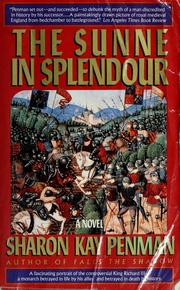
Start with The sunne in splendour (936 pages), the revisionist Richard III novel that runs across the whole Wars of the Roses. It is entirely standalone, it is the book Penman is still best known for, and at that length it is a fair test of whether her density of period detail suits you. If it does, everything else will.
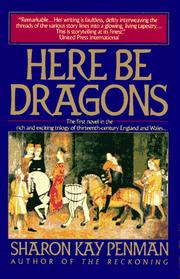
The reasonable alternative is Here be dragons (720 pages), which many readers consider her best single novel and which is also self-contained: Llywelyn the Great marries Joanna, King John's illegitimate daughter, into a country at war with her father. Either works as an opening. Choose the Richard III novel if you want the lowest-commitment test, and the Welsh one if you already know you like medieval historical fiction and want the strongest book first.
Publication order or chronological order
This is a genuine question with Penman, because her books run backwards. Internally the Plantagenet novels come first — the Anarchy of the 1130s and then Henry II and Eleanor of Aquitaine — followed by the Welsh trilogy in the thirteenth century, with the Wars of the Roses last. She wrote them in almost exactly the opposite direction.
Read in publication order anyway. The Welsh trilogy is her strongest sustained work and gets you into the habit of carrying a very large cast, which the Plantagenet books simply assume from page one. Reading chronologically front-loads the hardest sequence and puts the standalone that converts people at the end, where a reader who has already decided to quit will never reach it. Nothing in the books requires chronological order; the sequences share a period, not a plot.
One cosmetic note: our catalogue lowercases several of her titles (Falls the shadow, The reckoning, Devil's brood, Prince of darkness). That is cataloguing, not a different edition.
The Welsh trilogy
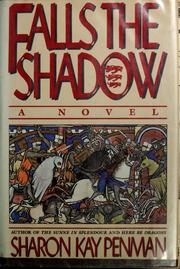
Here be dragons (720 pages) first. Then Falls the shadow (580 pages), which follows Simon de Montfort and the Barons' War alongside the Welsh story — broader in scope than the first book and considerably darker in outcome. Then The reckoning (592 pages), which closes the trilogy with Llywelyn ap Gruffydd and the English conquest of Wales. Read all three in order; the third is devastating precisely because of the two before it. This is the most emotionally punishing sequence she wrote, and readers should know that going in rather than after.
The Plantagenets
When Christ and his saints slept (759 pages) opens the Angevin sequence with the Anarchy — Stephen against Matilda, and Henry II's arrival — and needs nothing else read first. Time and Chance (496 pages) covers Henry, Eleanor and Thomas Becket, and is the book where her refusal to make Becket either a saint or a careerist does the most work. Devil's brood (792 pages) is the sons' rebellions and the collapse of the family; read it straight after.
Lionheart (400 pages) takes Richard I onto the Third Crusade and is much more military in emphasis than anything before it. King's Ransom completes the sequence with Richard's captivity and death — our catalogue files it without the leading article and holds no page count for its record, but it is a full-length novel in line with the rest.
The last novel
The land beyond the sea (688 pages) is the Kingdom of Jerusalem and Baldwin IV, the leper king. It is standalone, it is the furthest she worked from her home ground, and it was the last novel she published before her death.
The medieval mysteries
The Justin de Quincy books sit inside the Angevin timeline and are a quarter the length of the novels, in a completely different register. The queen's man (291 pages) has Justin acting as Eleanor of Aquitaine's agent while Richard is a prisoner. Cruel as the Grave (272 pages) is where the series settles into its rhythm, Dragon's Lair (329 pages) takes Justin into Wales and lets Penman reuse the ground of the Welsh trilogy at a lighter weight, and Prince of darkness (331 pages) centres on John. Four books, and the series stops there unfinished rather than concluded.
Where to stop
After the Welsh trilogy is a defensible place to leave it — you will have read her best work. Readers who want the full Angevin story should go through to King's Ransom and treat the mysteries as a palate cleanser rather than major Penman. The complete ordered list is at /paths/pt_ai_sharon-kay-penman.