Visible mending has one real prerequisite and it is not a stitch: a garment you are willing to ruin. The books below are ordered so that you close a hole in the first week, learn the sashiko running stitch properly after that, and only then read the arguments about why repair matters at all. Reversing that order is the commonest way people end up with a shelf of beautiful books and nothing mended.
The second thing worth knowing before you spend money: these divide into three kinds. Some are project manuals you work from with cloth in your lap, some are reference books you dip into mid-project, and three are essays about repair culture that will not teach you anything with a needle. Knowing which is which is most of the buying decision.
Close the first hole
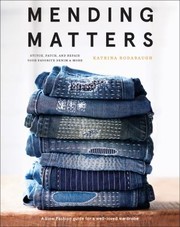
Mending matters is the book that made visible mending a movement in English and is still the fastest on-ramp. Katrina Rodabaugh has you patching and darning worn denim early in a 222-page book, and the governing idea is that the repair should be obvious rather than hidden. Its limitation is that it is very denim-focused.
Visible Mending fills that gap. Arounna Khounnoraj covers knits, wovens, felting and patching across a compact 144 pages, and is clearer than Rodabaugh about choosing a thread weight and needle for the fabric actually in front of you.
Mending Life, by sisters Nina and Sonya Montenegro, is the short illustrated handbook for the decisions the other two assume you already made: how to thread and knot, how to hold the work, whether a garment is worth saving. Buy it if you have not hand-sewn since school; skip it if you have. Tools for this whole stage: a sharp needle, thread, scissors, scrap cotton.
The stitch and the grid
Sashiko is a running stitch worked on a marked grid, and the technique books assume different things about your kit. Sashiko for Making and Mending is the one to start with — Saki Iiduka treats sashiko as repair rather than decorative embroidery, and covers the palm thimble and the load-several-stitches-then-push motion that Western books routinely skip. It is only about 80 pages and it changes how you hold the needle.
The Ultimate Sashiko Sourcebook is a reference, not a read-through. Susan Briscoe gives you the pattern library, the marking methods, and the distinction between one-stitch hitomezashi grids and continuous-line moyouzashi designs. Keep it open beside a project.
The geometry of hand-sewing is not a sashiko book and is here deliberately. Natalie Chanin reduces hand stitching to a grid and shows a hundred stitches as variations on a few motions, which makes the sashiko patterns stop looking like things to copy and start looking like a system. It ships with stitching cards; treat it as technique training.
Boro, projects, and the argument for repair
Briscoe's book on the layered, repeatedly patched indigo textiles of northern Japan is catalogued here simply as Book of Boro. Read it after the stitch stage, because boro is layering plus sashiko and layering only reads well once your stitch length is even. It is also the point to say plainly that the aesthetic came out of rural cloth scarcity and poverty, not out of a design choice.
Make and mend is Jessica Marquez's project book — bags, cushions, panels — for practising the stitch on something other than a repair. Wabi-Sabi Sewing is worth having for material choice, indigo and linen and hand-dyed cotton, more than for its imperfection framing, which is thinner than the cover suggests.
The last three do not teach technique so much as place it. Slow stitch names the practice — reduced pace, reclaimed and locally dyed materials. Mend! is the most opinionated book on the list, mixing history, method and polemic, and lands best once you can already mend. Repair Revolution widens the frame past cloth entirely, to repair cafés and right-to-repair law.
If you want the sequence with each stage's goals and a study plan attached, the full mending path lays it out book by book.