Start with Embers. It is short, it is the book that brought Sándor Márai back into print across Europe half a century after he wrote it, and its shape — two old men, one dinner, a question neither will ask directly — is the clearest statement of his subject, which is what a code of conduct costs the person who keeps it.
Two honest warnings before you buy it. First, almost nothing happens: one man talks for most of the book, and readers who need incident will find it static. Second, and more consequentially, the standard English text was made from the German translation rather than from the Hungarian. That is a documented feature of its publishing history and it has been criticised for years. The English Embers is a beautiful book; it is at two removes from what Márai wrote.
The novels, in a workable order
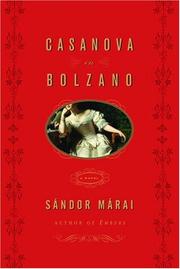
Casanova in Bolzano comes next and is the most enjoyable — Casanova after his escape from the Venetian prison, in a provincial town, in a long duel of arguments about desire and performance. It shares the theatrical staging of Embers and has more wit.
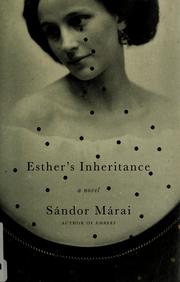
Esther's inheritance is shorter still, closer to a novella, and colder: a woman receives a visit from the man who ruined her life, and knowingly lets him do it again. If Embers worked for you, this is the concentrated version.
Portraits of a marriage is the largest of the translated novels and the best argument for him as a major writer. The same marriage is narrated in turn by the wife, the husband and the woman he leaves her for, and the reader is left assembling a truth that no single narrator holds. In Hungarian this was published as more than one book; the English edition gathers the parts, which is why it is considerably longer than the others.
The Rebels is early work — adolescents in a garrison town in the last summer of the First World War — and it is the first part of a much longer family cycle, most of which has never been translated. Read as a standalone it is oddly shaped, and that is our catalogue's problem and English publishing's, not yours.
The memoirs
Memoir of Hungary, 1944-1948 covers the siege of Budapest, the arrival of the Soviets and the closing of Hungarian literary life, which ended with Márai leaving the country. It is the best thing to read if you want to understand why the novels sound the way they do.
Land, land!... covers the same ground and the same years. Our catalogue lists both, and if you are ordering, check the Hungarian original named on the copyright page before buying two copies of what may be the same memoir under two English titles. This is a real hazard with Márai, whose works have reached English through several routes and several publishers.
What is missing, and why
Márai published something close to fifty books. English has a handful. The diaries he kept for decades — widely regarded in Hungary as central to his achievement — exist in English only in selections. There is no way to read him in English as Hungarian readers read him, and it is worth knowing that the reading order below is shaped by what translators and publishers happened to choose rather than by the work itself.
He left Hungary and refused to allow publication there while Soviet troops remained. He lived out his life in Italy and then in San Diego, and died by his own hand in 1989, months before the system he had refused to be published under collapsed.
Where to stop
Embers, Casanova in Bolzano and Portraits of a marriage are the three that make the case. Add Memoir of Hungary, 1944-1948 if the history draws you. The full sequence is on the path below, and you can browse more European literature paths from there.
Follow the full ordered path here: Sandor Marai Reading Order: Where to Start with the Rediscovered Hungarian Master.