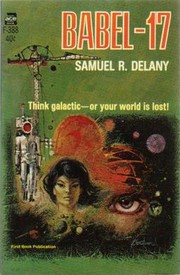
Start with Babel-17. It is 193 pages, it won a Nebula, and it states Delany's central idea in its clearest form: a poet-linguist is asked to decode a language that turns out to be a weapon, because the language builds the perceiver who uses it. Everything difficult he wrote later is an elaboration of that.
The alternative is to start with Dhalgren, which is what most people do and which is why most people never read a second Delany novel. Our record puts it at 879 pages. It begins and ends mid-sentence, forming a loop; nothing in it is explained; and the refusal to explain is the argument rather than an obstacle to it. That is a legible position once you have read three short novels in which Delany's sentences do something specific, and close to unbearable if it is your first contact with him.
One edition note before you order. The record our catalogue resolved for Babel-17 carries an ISBN registered in the German group, so it is likely a German-language edition rather than the English text. Check the language on the listing before buying — several of Delany's books have long publishing histories in translation, and this is the one on this list where the record makes it worth a second look.
The compact early novels
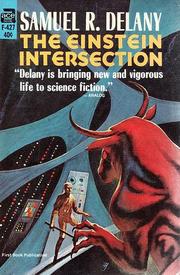
Babel-17 (193 pages, 1966) first. Then The Einstein intersection (155 pages, 1967), in which aliens re-enact human myth in the ruins we left behind; it is denser, and the first book where the structural games carry the emotional weight. Then Empire star (87 pages), a novella built as a Mobius strip and designed to be re-read the moment it ends — the shortest possible demonstration of Delany's interest in how a narrative knows what it knows.
The last of the space opera
Nova (224 pages, 1968) is a grail quest staged as interstellar space opera, with the Tarot and a worked-out economics of energy underneath it. It is the most purely entertaining novel he wrote and the last one that behaves like a genre novel. The ballad of beta 2 (144 pages) is slighter — a student reconstructing a folk song from a generation ship — but it is the clearest statement of his method, which is that the text is the evidence.
Dhalgren
Read it fourth. Bellona is a city cut off from the rest of America by something never named; a young man with no memory of his own name arrives, and the book circles. At 879 pages it is the longest thing here by a wide margin, and it is the single point on this path where readers quit. Give it a hundred pages before deciding, and know that the earlier novels are what make its refusals legible.
Neveryon and the late science fiction
Trouble on Triton (312 pages), originally published as Triton and subtitled An Ambiguous Heterotopia, was written directly against Le Guin's The Dispossessed: a society that can give its protagonist anything, and a protagonist who cannot be satisfied.
Tales of Nevèrÿon (264 pages, 1979) opens the sword-and-sorcery cycle Delany used as a theoretical laboratory — an essay on the invention of money, writing and slavery, in the form of linked tales. Note the diacritics in the series name, which are Delany's own joke about textual transmission and which make the books genuinely awkward to search for. Neveryóna (399 pages, 1983) is the second volume and a full novel; our catalogue also holds a later record under an unaccented spelling of the same work, so take one edition and do not buy both. The third and fourth volumes, Flight from Neveryon and Return to Neveryon, are not in our catalogue.
Stars in my pocket like grains of sand (368 pages, 1984) is the late masterpiece and the most emotionally direct of the science fiction. Its promised sequel was never finished, which is worth knowing before you start.
Delany on Delany
The motion of light in water (411 pages) is the memoir of the East Village in the 1960s: a Black, gay, dyslexic teenager writing science fiction and living a life the field had no vocabulary for. It is the single most useful book here for understanding the novels. Times Square Red, Times Square Blue (Sexual Cultures) (221 pages) is two essays on the gentrification of Times Square and what was destroyed with it, and the best short case for Delany as a major American essayist. About writing (422 pages) collects letters and essays on craft.
Content, as fact rather than warning: the memoir and several of the novels contain explicit sexual description, and the pornographic novels — Hogg and The Mad Man — are not on this path at all. The full ordered sequence is at /paths/pt_ai_samuel-r-delany.