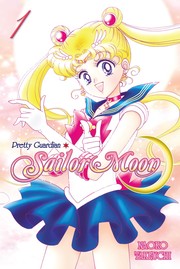
Start with Sailor Moon, Vol. 1 in the twelve-volume Kodansha edition and read the arcs in publication order. Naoko Takeuchi's manga is far denser than the anime made from it: Usagi, Luna and the first three Senshi all arrive inside a hundred pages, covering what a television season spends months on. If you are coming from the anime, expect to feel rushed for the first volume and then to prefer it.
The one genuine ordering question is where the prequel goes, and the answer is after volume three rather than before it. Codename Sailor V, Vol. 1 was written first and set first, so plenty of listings put it at the head of the sequence. Do not. It identifies Sailor V outright, and the main manga spends three volumes building to that reveal. Read it once Sailor Moon, Vol. 3 has closed the Dark Kingdom arc, at which point the prequel costs you nothing and gains you Minako's solo run at its funniest.
The Dark Kingdom arc: volumes 1 to 3
Sailor Moon, Vol. 1 (229 pages) and Sailor Moon, Vol. 2 (224 pages) are a single movement — the team completes and Tuxedo Mask's identity resolves — so read them without pausing. Sailor Moon, Vol. 3 (238 pages) ends the arc along with the Silver Millennium backstory that every later arc assumes you now hold. It is the first natural stopping point in the series.
The prequel, read here
Codename Sailor V, Vol. 1 (280 pages) is lighter, funnier and visibly rougher than the main series — it is the book Sailor Moon grew out of. Codename Sailor V, Vol. 2 finishes Minako's story and runs straight into her arrival in the main series. Two volumes is the whole of it, so this is a short detour rather than a second commitment.
Volume 4, and the gap after it
Sailor Moon, Vol. 4 brings Chibi-Usa and the time-travel premise that reorganises the rest of the series. Two notes on this record. Its page count reads 126, roughly half of its neighbours; that is the figure our catalogue holds for the edition it resolved, not a guide to how long the book is. And volumes 5, 6 and 7 have no distinct English record here — every form we probed resolves back to volume 1 — so read those three from your own set or a library before rejoining at volume 8.
Infinity and Dream: volumes 8 to 11, and an edition trap
Check the edition before you order volume 8. The record our catalogue holds for Sailor Moon Vol. 8 is from the discontinued Mixx and TokyoPop line, dated 1995, while Sailor Moon, Vol. 9, Sailor Moon, Vol. 10, Sailor Moon, Vol. 11 and Sailor Moon, Vol. 12 are the modern Kodansha edition. Those two lines do not share a volume breakdown — the older release followed the original Japanese volume divisions rather than the twelve-volume reissue — so a volume 8 from one line is not the same content as a volume 8 from the other. Buy the whole run in one edition.
With that settled, Sailor Moon Vol. 8 is the Infinity arc at full strength, with Haruka, Michiru and Setsuna operating on a moral logic the inner Senshi cannot accept, and it is the best argument that this is not a children's comic. Sailor Moon, Vol. 9 (257 pages) is its climax and resolves Hotaru's story; read it directly after. Sailor Moon, Vol. 10 (236 pages) opens the Dream arc in a deliberately different register, giving Chibi-Usa interiority for the first time, and Sailor Moon, Vol. 11 concludes it.
Where to stop
Sailor Moon, Vol. 12 is the Stars arc and the end of the manga, and its ending differs substantially from the anime's. Treat it as the real conclusion — nothing after it continues the story. Sailor Moon Short Stories 1 (198 pages) collects side stories scattered across the timeline, several of which assume you know how volume 12 ends, so read it last as a coda rather than trying to interleave it chronologically.
The full ordered sequence, with the gaps marked, is at /paths/pt_ai_sailor-moon.