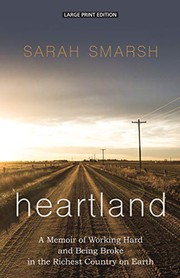
Read the reporting before the theory. Start with Sarah Smarsh's Heartland, a memoir of five generations of working poverty on a Kansas wheat farm written by someone who left and can still speak from inside it, then Amy Goldstein's Janesville, which follows a Wisconsin town for years after the GM plant closed in 2008, including the retraining programmes that were supposed to fix it and mostly did not.
That order is deliberate. The middle of this path holds five books that reach flatly incompatible conclusions about overlapping populations, and they are much easier to assess if you already know what a plant closure or a generation of rural poverty looks like day to day. This article will not tell you which of the five is right, because that is a live argument among people with better evidence than a reading list.
One family, one town, one factory
Heartland establishes that rural poverty is a class story with a long history rather than a recent political mood. Janesville is the best single case study of deindustrialisation, and it withholds judgement long enough for you to form your own. Brian Alexander's Glass House takes apart Lancaster, Ohio — once a model American town — through the leveraged buyouts of the glass plant that built it. Pair it with Janesville deliberately: the villain here is finance rather than trade, which is a different causal story about the same symptom.
What the economy did
George Packer's The Unwinding braids a factory worker, a Washington operator and a biodiesel entrepreneur into a portrait of institutions coming apart from 1978 onward. Sam Quinones's Dreamland tells how prescription opioids and Mexican black-tar heroin arrived in small-town America simultaneously, following both supply chains. Read Dreamland before any book that treats rural drug deaths as evidence for a political argument, because Quinones supplies the mechanism those arguments assume.
Five explanations that cannot all be right
This is the argument of the subject and it should not be flattened into a consensus. Each of these books is doing something different, from a different standpoint, and they contradict each other.
J. D. Vance's Hillbilly Elegy is a memoir arguing from culture and personal responsibility, and it set the terms of the debate in 2016. It also drew the sharpest scholarly pushback, largely for generalising from one family to a region; read the criticisms alongside it rather than after it. Katherine Cramer's The politics of resentment is political science built from years of sitting in Wisconsin gas stations and diners, and finds a durable rural consciousness — a sense that decisions, money and respect all flow to the cities. Her conclusion is about distribution and recognition, not character.
Robert Wuthnow's The left behind is a sociologist of religion's account, built on hundreds of interviews, arguing that what small towns feel is the erosion of a moral community rather than economic grievance alone. On comparable evidence he disagrees with Cramer about what the anger is about. Arlie Hochschild's Strangers in their own land spent five years in Louisiana bayou country asking why people harmed by industrial pollution oppose environmental regulation, and answers with a deep story about waiting in line and others cutting in; it is sympathetic by design, which is both its method and the standard objection to it. Jonathan Metzl's Dying of Whiteness is the most contested: he argues that racial resentment leads white voters in Missouri, Tennessee and Kansas to back gun, health and school policies that measurably shorten their own lives, and the mortality claims have been disputed on their statistics.
Read all five. The useful test at the end is not which one you liked, but what evidence would have changed each author's mind.
The longer history
None of this began in 2016. Nancy Isenberg's White trash runs four hundred years of American class contempt from colonial waste people through twentieth-century eugenics to trailer-park stereotypes, and reframes the previous stage as the latest round of a very old argument about deserving and undeserving poor. Thomas Frank's What's the matter with Kansas? popularised the puzzle of voting against apparent economic interest in 2004 and is the direct ancestor of Cramer, Hochschild and Metzl — and a thesis Cramer's fieldwork partly undercuts. A records note: our catalogue entry for Frank carries a Spanish translator and an unrelated name in the author field, and the ISBN is a Spanish publisher's; the ISBNs we hold for Hillbilly Elegy and The Unwinding are also registered to Spanish and German houses. The works are the ones described here, but check the language of the edition before ordering those three.
What is actually being tried
End on evidence rather than diagnosis. Our towns is James and Deborah Fallows flying a small plane between dozens of American towns looking for local renewal and finding more than the national narrative predicts; it is deliberately optimistic and openly selects on success. Michelle Wilde Anderson's Fight to Save the Town is a legal scholar on Stockton, Josephine County, Lawrence and Detroit, and the specific municipal-finance and governance repairs people attempted. It is the most policy-literate book here, and it treats decline as something with levers rather than a mood.
The full ordered list is on the rural America reading path.