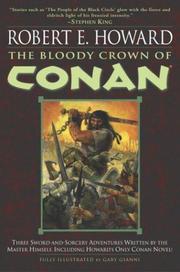
Start with The coming of Conan, the first of the three modern restored volumes, which prints the stories in the order Howard wrote them from unedited Howard texts. Then The Bloody Crown of Conan and The Conquering Sword of Conan. Those three books are the whole of Conan by Robert E. Howard. Everything else with Conan on the cover is by somebody else.
The edition matters more here than the order, and buyers need to be careful for two separate reasons. First, Howard is in the public domain, so the catalogue is thick with unedited scan reprints that carry a real title and no editorial work at all. Second, our own records are imprecise: the record we hold under the title The coming of Conan is the older 1953 Gnome Press collection of that name, not the restored volume. The book to look for is the Del Rey trade paperback, The Coming of Conan the Cimmerian, edited with the original manuscript texts. The same caution applies to Kull and Bran Mak Morn below.
Why the order was broken in the first place
Howard wrote the Conan stories out of sequence for the pulp magazine Weird Tales between 1932 and 1936, with no interest in a biography. In the paperback era L. Sprague de Camp and Lin Carter reordered them into a fake life story, rewrote Howard's prose, completed unfinished drafts and inserted outright pastiches under his name. Millions of readers met Conan that way. The restored three-volume sequence, published from 2003, undoes all of it. That is the real controversy in Conan reading order, and it is not evenly balanced: read the restored texts.
The three restored volumes
The coming of Conan holds the early stories. The Bloody Crown of Conan contains The Hour of the Dragon, the only full-length Conan novel Howard wrote, which circulated in paperback for decades as Conan the Conqueror — reading it inside the collection avoids buying the same story twice. The Conquering Sword of Conan has Red Nails and Beyond the Black River, the late stories where Howard is at his peak and the frontier pessimism is fully worked out.
Howard's other heroes
The Savage Tales of Solomon Kane is the complete Solomon Kane, a Puritan avenger wandering Africa and Europe; he is bleaker and stranger than Conan and the character most Howard readers end up preferring. Kull is Kull of Atlantis, the brooding king Howard invented before Conan and drew on for The Phoenix on the Sword. Bran Mak Morn is the Pictish king, and contains Worms of the Earth, generally rated Howard's finest single story.
Records to watch on both of those: our Kull record is an earlier collection rather than the Del Rey restored volume, and our Bran Mak Morn record is a French-language edition. The restored editions to look for are titled Kull: Exile of Atlantis and Bran Mak Morn: The Last King.
Beyond sword and sorcery
Four-fifths of Howard's output has nothing to do with fantasy. The horror stories of Robert E. Howard collects the Lovecraft-circle weird fiction including Pigeons from Hell. El Borak and Other Desert Adventures is Francis Xavier Gordon in Afghanistan and Arabia, Howard's most purely kinetic action writing with none of the supernatural machinery. Sword Woman and Other Historical Adventures has Dark Agnes de Chastillon and the crusader stories, and is the evidence people cite on both sides of the argument about whether Howard was a proto-feminist or an accident. The Black Stranger is the Bison Books collection of his American frontier writing, edited from original manuscripts, and the clearest evidence that Texas rather than Cimmeria was his real subject.
Content, stated plainly
Howard's fiction contains explicit racial characterisation typical of 1930s pulp magazines. It is not confined to one book: peoples are described in racial terms throughout the Conan stories, and several of the pieces in The horror stories of Robert E. Howard are unpleasant on exactly that axis. Restored texts restore this too, since it is what he wrote.
The samplers and the life
Crimson Shadows: The Best of Robert E. Howard, Volume One and The Best of Robert E. Howard Volume 2, the latter also published as Grim Lands, span every genre he worked in; expect heavy overlap with the collections above, because they are samplers rather than supplements. Finish with Blood and Thunder: The Life and Art of Robert E. Howard, Mark Finn's biography, which dismantles the de Camp-authored image of Howard as a stunted recluse and puts him back in the Texas oil-boom culture he wrote out of.
The full ordered path is at the Robert E. Howard path.