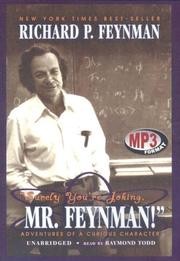
Start with Surely You're Joking, Mr. Feynman. It contains no physics worth the name and that is precisely why it works as an entry: it is a collection of transcribed anecdotes, it is very funny, and it establishes the voice that makes the actual physics books readable.
The alternative most people try is The Feynman Lectures on Physics, on the reasonable assumption that the famous lectures are the place to begin. They are not, and the reason is documented rather than snobbish — the lectures were written for Caltech undergraduates who already had calculus, and by Feynman's own later assessment the course did not fully succeed even for them. They are a magnificent reference and a poor first book.
The two anecdote books
Surely You're Joking, Mr. Feynman is first. One honest note before you buy it: the stories are self-selected and self-narrated, and several episodes — particularly the chapters about picking up women in bars, and the account of nude sketching — have drawn sustained criticism for how they treat the women in them. That criticism is not a fringe position, and readers should meet the book knowing it rather than being ambushed halfway through.
What Do You Care What Other People Think? is the second volume and is a different sort of book. Its first half is about his first wife Arline and her death, and it is the only place he writes without a performance; its second half is his minority report on the Challenger disaster, which is one of the clearest pieces of public technical writing anyone has produced.
The physics books, in order of difficulty
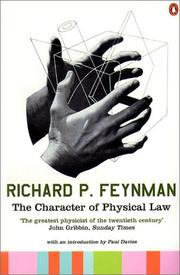
Six Easy Pieces is extracted from the lectures and is the correct on-ramp — six chapters chosen because they need almost no mathematics. The Character of Physical Law is next and is the best of the lot for a reader who wants ideas rather than technique: it is a set of lectures on what physical laws are like as objects, and it contains the clearest available statement of why nobody understands quantum mechanics.
Then QED. This is the one to hold out for. It teaches quantum electrodynamics — the theory he shared a Nobel for — to a reader with no mathematics at all, using nothing but little arrows that get added together. It should not work and it does. If you read one Feynman book that is actually about physics, read this.
Six not-so-easy pieces is the sequel to the easy ones and pushes into relativity and symmetry; it asks for some comfort with algebra and vectors. The Pleasure of Finding Things Out gathers essays, interviews and talks, and overlaps noticeably with the two anecdote volumes — if you have read those, expect repetition.
The Feynman Lectures on Physics belongs at the end. It is three volumes, not one, whatever a catalogue entry suggests, and the complete text is available free and legally online from Caltech, which is worth knowing before you buy a boxed set. Use it as a reference you dip into after Six Easy Pieces has shown you the register.
The biography
Genius, by James Gleick, is the outside view — the one that reconstructs the physics career properly, puts the Manhattan Project and the Nobel work in context, and is willing to examine the myth-making that Feynman himself did a great deal to encourage. Read it after the anecdote books, so you have something to check it against.
Where to stop
For most readers: Surely You're Joking, Mr. Feynman, then Six Easy Pieces, then QED, and stop. That is perhaps six hundred pages and it delivers nearly all of the value. Everything beyond it is for people who have found they want more. The full ordered path, with the difficulty steps marked, is below.
Follow the full ordered path here: Richard Feynman Reading Order: Which Book to Read First.