Start with A clubbable woman, the 1970 debut, published as A Clubbable Woman. It is a conventional English police procedural with an unconventional double act already fully formed — Andy Dalziel, gross and shrewd, and Peter Pascoe, graduate and uneasy — and at 256 pages it is a quick read. The obvious alternative is to start with On Beulah Height, which most of Hill's admirers name as his masterpiece. Do not. That book's power depends entirely on having lived with these people for twenty years; opened cold it is a well-written novel about grief instead of a devastating one.
So: publication order, all the way through. This is one of the few crime series where the order is not a matter of convenience but the actual subject. Hill began with a competent procedural and ended with novels carrying literary allusion, unreliable narration and a genuine tragic register, and reading in sequence means you watch him outgrow his own template rather than being told he did.
The early procedurals
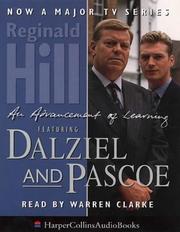
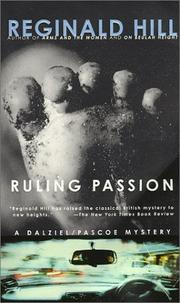
A clubbable woman, then An advancement of learning (1971), which puts the pair on a campus and shows Hill's real interests arriving early: an argument about class and education, and a plot that cares as much who these people are as who did it. Then Ruling passion (1973), which is Pascoe's book — his friends are murdered, and Hill uses it to build the private life that every later novel damages.
Honest warning: these three are good, not extraordinary. If the 1970s register wears on you, keep going. The series is not what it looks like here.
The 1980s
A killing kindness (1980) is a serial-killer plot Hill uses to play with quotation and voice, an early rehearsal for what he does twenty years later. Deadheads (1983) builds its structure around a suspect who may simply be extraordinarily lucky; Hill withholds certainty on purpose, which is the trick the late books run on. Under world (1988) drops the miners' strike into Yorkshire, gives the series a political spine, and does damage to the Pascoe marriage that the later novels never repair.
The leap
Bones and silence (1990) won the Gold Dagger and is the acknowledged turning point: a medieval mystery-play production runs alongside the investigation and Dalziel plays God, literally. Pictures of Perfection (1994) is a Jane Austen pastiche with almost no crime in it — some readers find it slight, and it is also the most purely enjoyable book in the run. The wood beyond (1996) braids Pascoe's great-grandfather in the trenches with a present-day case.
The two peaks
On Beulah Height (1998, 440 pages) is the one: a drowned Yorkshire village, a drought exposing it, and a decades-old disappearance surfacing with the water. Grief rather than detection is the subject.
Dialogues of the Dead (2001) is the opposite mode — a killer who writes literary dialogues, a plot built from wordplay and untrustworthy text. It does not end. Death's jest book, published as Death's Jest-Book in 2002 and running 558 pages, is its second half and is genuinely incomplete without it. Buy them together or do not start.
The late books
Death Comes for the Fat Man (2007), published in the United States as The Death of Dalziel, nearly kills him with a bomb and then spends much of its length with him unconscious, asking what the series has been resting on. Midnight Fugue (2009) is the last novel, unfolding across a single Sunday in something close to real time. Hill died in 2012; there is no completion and no summing-up, which is its own kind of honesty.
What this path leaves out
Fourteen of the twenty-four Dalziel and Pascoe novels are here, chosen for the shape of the arc. Missing from our catalogue are strong middle-period books including Exit Lines, Child's Play, Recalled to Life and Arms and the Women, and any of them slots into publication order without trouble. Hill's other work is out of scope entirely: the Joe Sixsmith novels about a redundant Luton lathe operator turned private investigator, and the standalones, some published under the name Patrick Ruell. None of it is required, and none of it is where the reputation sits.
The full sequence with lengths and stage notes is at the Reginald Hill path.